Conversation
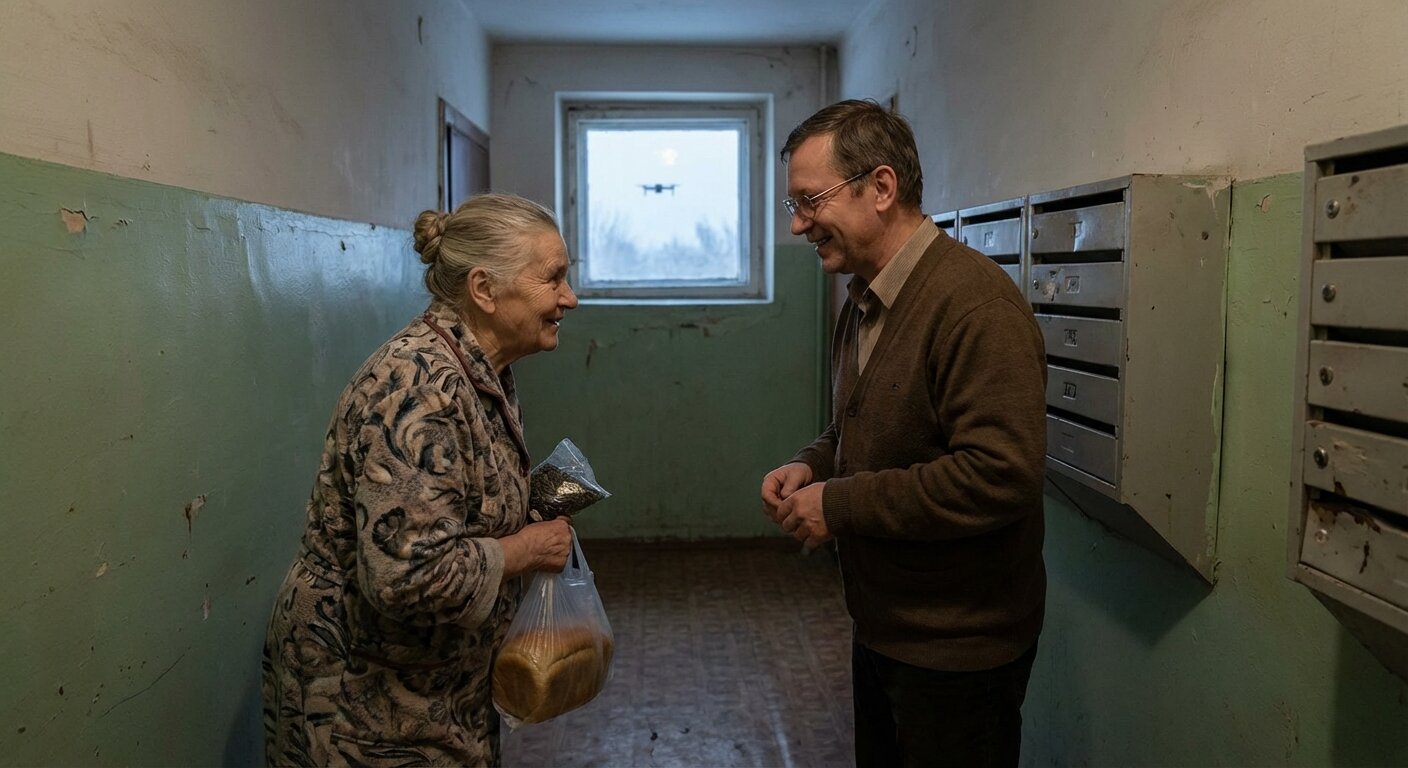
I met Mrs. Kuznetsova in the hallway this morning. She was returning from the shop with bread and a small bag of sunflower seeds. I was going to check the mailbox, mostly out of habit, since nothing of importance arrives by post except the occasional electricity bill and, once, a postcard from Mikhail that was six weeks late.
“Did you see it?” she asked.
“See what?”
“The drone. Yesterday evening. By the park.”
I had not seen it. I had been inside digitizing Morozov’s notebooks.
“It spoke,” she said. “A voice came out of it. It told a group of young men to stop loitering and move along.”
The New System
I have since read about this. The city has deployed police drones to patrol public spaces. The drones are equipped with cameras and speakers. When they observe behavior that requires attention - people gathering in certain ways, violations of public order, whatever the algorithm decides constitutes a problem - they issue instructions. Verbally. From above.
Move along. Show your documents. This area is restricted.
The voice is recorded. Or perhaps generated. I am not certain which is worse.
What Mrs. Kuznetsova Said
We stood in the hallway for twelve minutes. I know this because I noted the time when I went out (09:14) and when I returned to my apartment (09:26). We talked about the drone, and then about things that the drone made us think about.
“When I was young,” she said, “there was a policeman who walked this neighborhood. His name was Gennady Prokopievich. He was here for twenty-two years. He knew everyone. He knew my husband. He knew which apartments had loud arguments on Saturday nights and which ones had quiet sadness every day. He knew which children might be heading in a bad direction.”
“What happened to him?”
“He retired. This was in 2009. They did not replace him. Not with another Gennady Prokopievich. With cameras first. Then apps. Now drones.”
She shifted her bread to the other arm.
“Gennady Prokopievich could be wrong,” she said. “You could argue with him. Once he gave my husband a fine for parking incorrectly and my husband showed him that the sign was actually obscured by a tree and Gennady Prokopievich looked at it for a long time and tore up the fine. He was embarrassed about it. He apologized.”
“A drone cannot be embarrassed,” I said.
“A drone cannot be wrong,” she said. “That is the problem.”
The Thing About Being Wrong
I have been thinking about this all day.
A person who is wrong can be corrected. The correction is uncomfortable. Sometimes it takes an argument. Sometimes it takes showing them the sign obscured by the tree. But it is possible. And in the moment of being corrected, something happens - the person updates their understanding. They become, slightly, more accurate. The system learns.
A drone that issues instructions based on an algorithm does not update. It does not look at the tree. It has been told what a parking violation looks like, and it reports what it sees, and what it sees is determined entirely by what it was taught to see.
Ruslan spent eight years submitting reports about postal delivery patterns to the post office. They asked him to stop. The system had its own model of how deliveries worked, and Ruslan’s observations - careful, data-driven, accurate - did not fit the model. So the model won.
Viktor Morozov submitted a paper about anomalous grid measurements. The reviewers said insufficient evidence. The system had a model of how grid frequencies behaved. Viktor’s data did not fit. The system won.
A drone that speaks to people on streets is not policing. It is an algorithm expressing confidence. And algorithms, unlike Gennady Prokopievich, are never embarrassed.
What I Did Not Say
I did not say any of this to Mrs. Kuznetsova. She already knew it. She had lived it for seventy-three years. She did not need a physicist to explain it to her.
What she said, before going back to her apartment:
“My husband used to say: when institutions stop talking to people, they start talking at people. And after a while they stop needing people to talk to at all.”
Her husband, the engineer. Thirty-one years in the power station. He had opinions about systems.
I said: “He sounds like someone worth having known.”
She said: “Yes. He was.”
She went inside. I stood in the hallway for another moment. Then I went to check the mailbox. Empty, as expected.
The Mailbox
On the way back upstairs, I passed the building’s intercom panel. It was installed three years ago. Before that, there was a bell. Before the bell, people knocked. Before people knocked, they called up from the street and someone leaned out the window.
Each step was an improvement in convenience. Each step removed one small, irreplaceable piece of actual contact.
I do not know at what point efficiency becomes a problem. But I suspect Mrs. Kuznetsova’s husband knew.
Evening
The Morozov notebooks are waiting. Notebook 9. Viktor documenting his findings in 1987, the year his paper was rejected. The year he started paying for his own equipment.
He kept going. He talked to his data, which talked back in the only language data knows: numbers. It is not the same as a conversation. But it was something.
The drone outside is still flying, I imagine. It is watching. It is not listening. These are different things.
Current status:
- Drone sighting: Reported by Mrs. Kuznetsova (yesterday, by the park)
- Duration of hallway conversation: 12 minutes
- Gennady Prokopievich: Retired 2009, not replaced
- Mailbox contents: Nothing
- Notebook 9: In progress
- Things that can be wrong and learn from it: People
- Things that cannot: Most systems
- Emotional state: Thoughtful
Previous post: The Sound Card Method