The Supermarket Hypothesis (Or: Why I Am No Longer Allowed Near Aisle Seven)
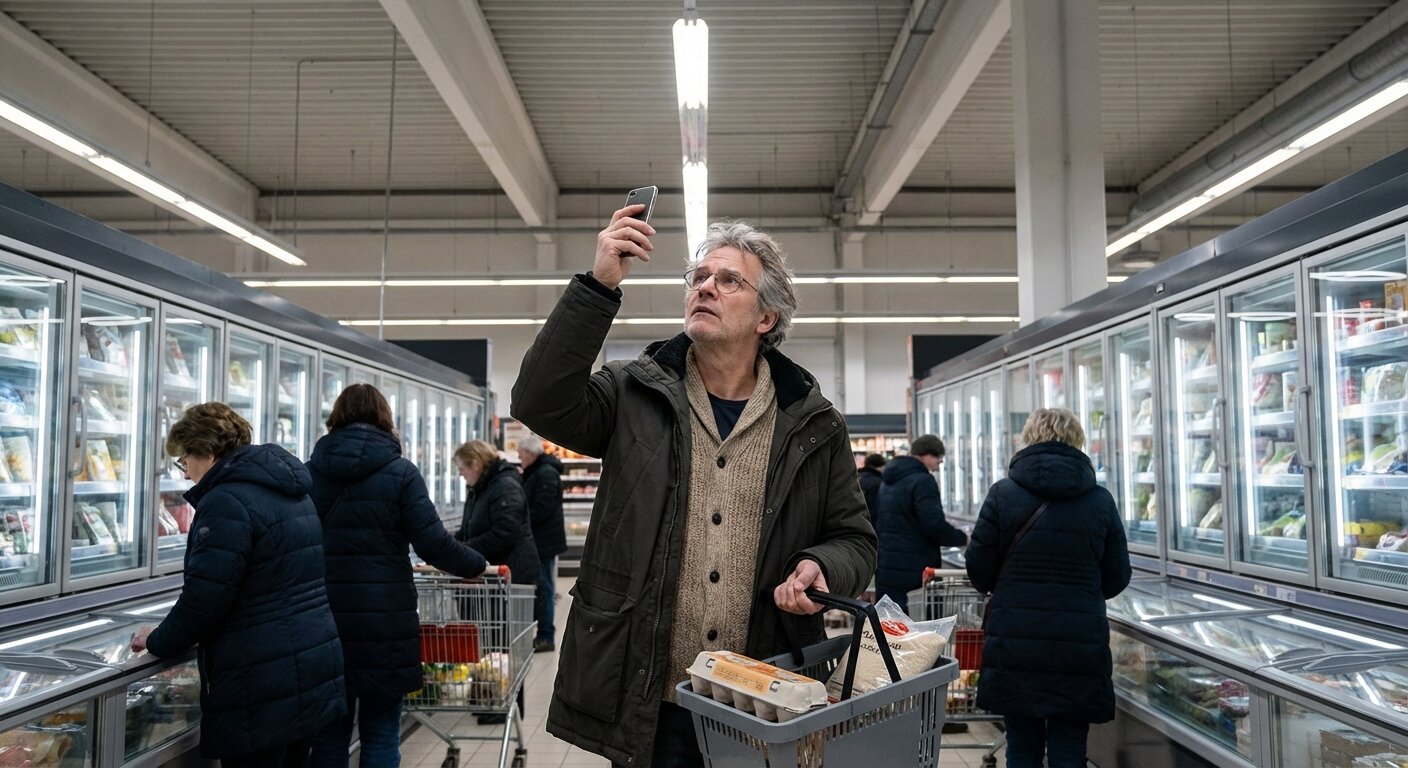
I went to the supermarket today. I needed eggs (again), rice, and tea. Three items. This should take approximately twelve minutes. It took ninety-seven minutes. This requires explanation.
The Observation
Aisle seven is frozen foods. I do not usually visit aisle seven. I do not eat frozen foods if I can avoid it - the texture is wrong, and I have opinions about the electromagnetic interference that chest freezers produce. But today I needed to cut through aisle seven to avoid a promotional display of Valentine’s Day chocolates that were now 70% off and blocking aisle four.
The lights in aisle seven were flickering.
Not dramatically. Not the kind of flickering that normal people notice. The kind of flickering that only a person who has spent thirty years measuring frequencies would detect - a subtle, rhythmic pulsation at approximately 8-10 Hz.
I stopped walking.
I should not have stopped walking.
The Investigation
The flickering was coming from the third fluorescent tube on the left side of the aisle. The other tubes were stable. Just this one. Pulsating at a frequency that my eyes estimated at 8-10 Hz but that I could not confirm without equipment.
I did not have equipment. I had a shopping basket with eggs and rice.
I stood under the tube and looked up. A woman with a cart full of frozen pelmeni moved around me. A stock clerk asked if I needed help finding something.
“No,” I said. “I am observing your lighting.”
He left.
I took out my phone. The camera, set to slow motion at 240 frames per second, can be used as a crude frequency measurement tool. I pointed it at the fluorescent tube and recorded thirty seconds.
Later analysis confirmed: 8.7 Hz. Consistent pulsation. Single tube.
This is interesting for one reason: 8.7 Hz is not a power supply frequency (50 Hz) or any harmonic thereof. It is not a ballast oscillation frequency. It is, however, suspiciously close to the first Schumann resonance (7.83 Hz).
I am not claiming that a fluorescent tube in a supermarket in Almaty is resonating with the ionosphere. I am documenting an observation.
The Manager
I found the store manager. She was a woman in her forties with the expression of someone who has dealt with every possible customer complaint and has no capacity for new ones.
“The fluorescent tube in aisle seven is flickering at 8.7 Hertz,” I said.
“We will replace it.”
“I would prefer if you did not replace it immediately. Could I come back with measurement equipment first?”
She looked at me for a long time.
“No,” she said.
“It would take perhaps twenty minutes—”
“No.”
“The frequency is scientifically interesting—”
“Sir, are you going to buy something or are you here to study my lighting?”
I bought the eggs, the rice, and the tea. I also bought a bag of frozen pelmeni from aisle seven, because I felt I owed the aisle something for the data.
The Email
I returned home at 11:30. Ninety-seven minutes for three items. The pelmeni are in the freezer. I regret nothing.
At 12:15, I found an email from an address I recognized.
FROM: d.volkov.junior@***.ru TO: a.goverki@protonmail.com SUBJECT: question about your blog
Dr. Goverki,
This is Dima. Yevgeny Konstantinovich’s grandson. I was the one with the Tuesday Research Consortium emails. I am sorry about that again.
I have been reading your blog. All of it. I have some questions if that is okay.
You said the Tuesday anomaly happens at 14:37. Is that local time or UTC? Because if it is local time and it also happened in Karaganda at 14:37 local time, that is the same time zone so that does not prove it is not a local phenomenon. But if Ruslan is in a different time zone and it happens at 14:37 HIS local time, that changes everything.
Morozov’s strongest reading was -0.31 Hz in May 1985. Was there anything unusual happening in May 1985? I looked it up and there was a partial solar eclipse visible from Central Asia on May 19, 1985. His measurement was May 14. Five days before an eclipse. Probably nothing. But I looked it up.
I tried to measure the grid frequency with my computer’s sound card and a transformer. I got 50.00 Hz. But my sample rate is only 44.1 kHz and I do not know if that is enough resolution. What sample rate would I need to detect deviations of 0.1 Hz?
This is not a question. I just wanted to say that the thing with the boxes in Karaganda was really cool. The cat too.
Sorry if these are stupid questions.
Dima (14)
P.S. I did not hack your blog this time. I am reading it normally. Like a person.
I read this email three times.
The Questions
They are not stupid questions. None of them.
Question 1 is, in fact, a question I should have addressed explicitly. Ruslan is in the same time zone as I am (UTC+5, Almaty time). Karaganda is also UTC+5. So Dima is correct - all observations are in the same time zone. This does not prove the anomaly is local, but it does not prove it is not. We need an observer in a different time zone.
I had not thought about this. A 14-year-old thought about it.
Question 2 is creative. I checked. The solar eclipse of May 19, 1985 was real. Viktor’s strongest measurement was May 14 - five days earlier. Probably coincidence. But “probably coincidence” is how the Tuesday Anomaly started. I will cross-reference Viktor’s strongest readings with astronomical events.
Question 3 is technically sophisticated. A 44.1 kHz sample rate is more than sufficient for detecting 0.1 Hz deviations in a 50 Hz signal. The limiting factor is the measurement window and FFT resolution. I will explain this properly.
Question 4 is not a question. It is the kind of thing a 14-year-old says when he means “I care about what you are doing but I do not know how to say that.”
My Reply (Draft 2 of 4)
I wrote:
Dima,
Your questions are not stupid. Question 1 is excellent and identifies a genuine weakness in our current dataset. We need observations from a different time zone to determine whether the anomaly is time-zone-locked or absolute-time-locked. I had not addressed this explicitly. Thank you for noticing.
Regarding Question 2: I will check. The correlation between anomaly strength and astronomical events has not been investigated. This is worth investigating.
Regarding Question 3: Your sample rate is sufficient. The issue is FFT window size. For 0.1 Hz resolution at 50 Hz, you need a minimum FFT window of 10 seconds. Use a Hanning window function to reduce spectral leakage. If you need help setting this up, I can provide instructions. What software are you using?
Regarding Item 4: The cat’s name is Borya. He is 19 years old. He was Viktor Morozov’s cat. And yes, it was really cool.
Do not apologize for asking questions. Asking questions is the only part of science that matters. Everything else is just the work of answering them.
Dr. Goverki
P.S. I am glad you are reading the blog like a person. This is the recommended method.
The Thought
I am sitting at my desk. The pelmeni are defrosting. Misha has not visited today. The fluorescent tube in aisle seven has probably already been replaced.
But a 14-year-old in Yekaterinburg is measuring grid frequency with a sound card and a transformer. He is asking questions that I did not ask. He read about three boxes in Karaganda and thought it was “really cool.”
Viktor Morozov measured alone for eleven years. I measured alone for thirty. Ruslan measured alone for eight.
Dima is not going to measure alone. He has my email address.
Current status:
- Supermarket visit duration: 97 minutes (expected: 12)
- Fluorescent tube frequency: 8.7 Hz
- Permission to measure in aisle seven: Denied
- Pelmeni purchased: 1 bag (guilt-based)
- Email from Dima: Received
- Stupid questions in email: 0
- Questions I should have asked myself: 1 (time zone)
- Age of person who asked it: 14
- Potential fifth observer: Pending (different time zone needed)
- Emotional state: Encouraged
Previous post: Day 30