The Art of Online Equipment Acquisition
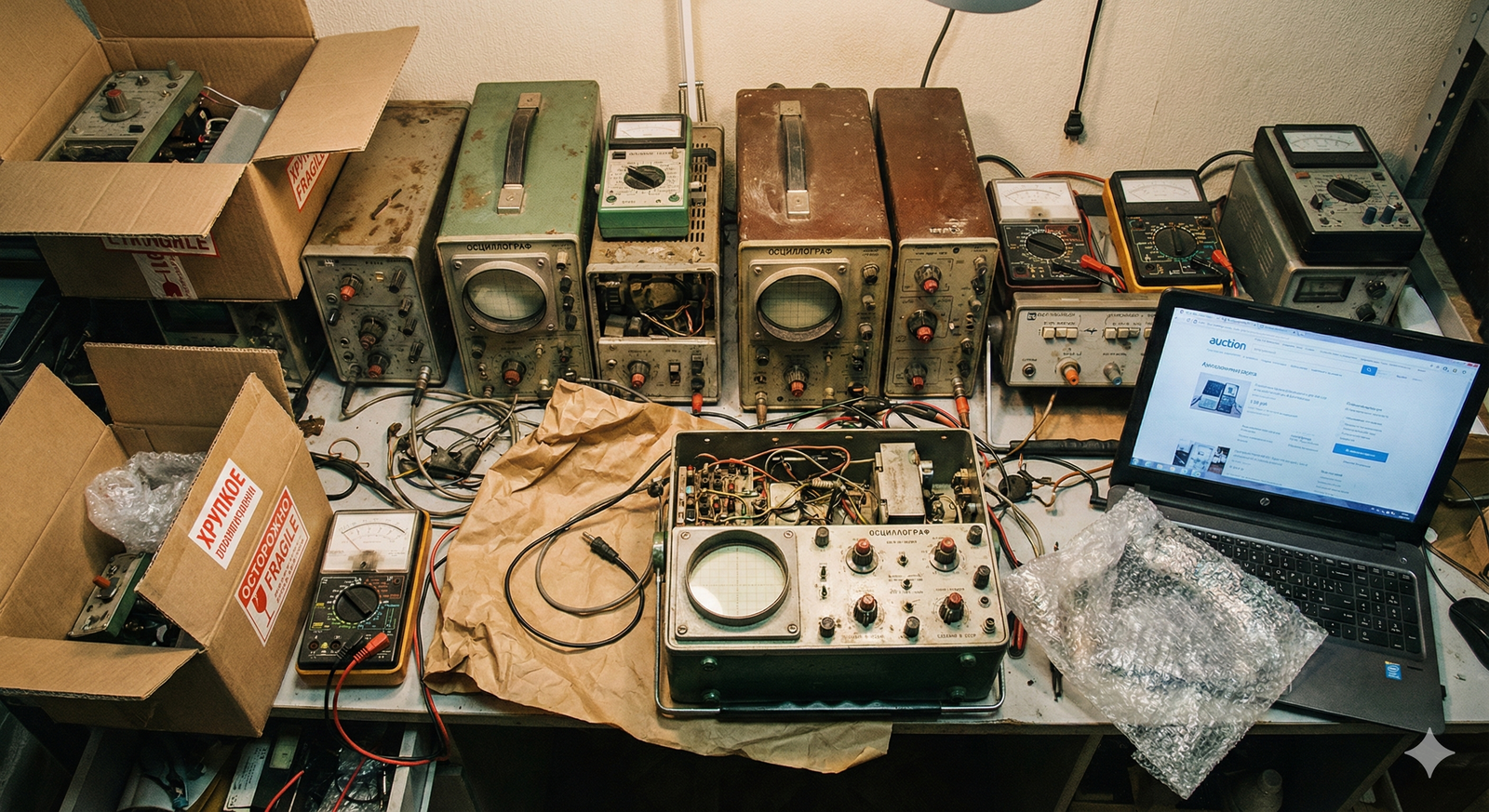
One of the challenges of conducting independent research in 2025 is acquiring proper measurement equipment on a budget that can best be described as “minimal.”
Fortunately, the internet has made it possible to purchase decommissioned scientific instruments from around the world, often at prices that suggest the sellers have no idea what they possess. This is both a blessing and a source of constant disappointment.
The Process
My methodology for online equipment acquisition has evolved over the past decade:
Step 1: Search with Vague Terms
Sellers of Soviet-era equipment often do not know the proper terminology. I have found valuable instruments listed as:
- “Old electrical box with dial”
- “Vintage Russian measurement thing”
- “Soviet oscillator??? works maybe”
- “Laboratory equipment from grandfather”
The key is to search for misspellings, approximate descriptions, and desperate-sounding listings.
Step 2: Examine Photos Carefully
Most sellers provide 2-3 blurry photographs taken with inadequate lighting. From these, I must determine:
- Whether the device is actually what I need
- If any critical components are missing
- The approximate state of decay
- Whether those are water stains or something worse
I have developed what I believe is a professional-level skill at identifying equipment from partial shadows and out-of-focus control panels.
Step 3: Ask Questions That Cannot Be Answered
“Does the calibration hold within ±5% over the full range?”
The seller responds: “It turns on. Has some lights.”
This tells me nothing and everything.
Step 4: Make Peace with Uncertainty
Eventually, I click “Buy Now” and enter a state of philosophical acceptance. Either:
- The device will arrive and work (15% probability)
- The device will arrive and partially work (40% probability)
- The device will arrive and not work but be repairable (30% probability)
- The device will arrive and be completely unusable (10% probability)
- The device will not arrive at all (5% probability)
Recent Acquisitions
Success: Б5-71/3 Function Generator (1987)
Purchased for $35 USD from a seller in Yekaterinburg who described it as “old radio equipment, has buttons.”
Status: Partially functional
- Frequency range: Works from 10 Hz to ~200 kHz (specifications claim to 1 MHz)
- Amplitude control: Functions, but not linearly
- Waveforms: Sine wave is perfect, square wave is more of a “rounded rectangle wave,” triangle wave resembles “disappointed hill wave”
Overall assessment: Worth $35
Mixed Result: Oscilloscope Probes (Unknown Origin)
Purchased a set of five oscilloscope probes for $12 USD. Description: “Oscilloscope accessories, Soviet, vintage.”
Status: Three work perfectly, one is intermittent, one appears to be a broken pen
Overall assessment: $12 for three working probes is acceptable; the broken pen adds character
Disaster: “Working Power Supply”
Purchased for $60 USD what was advertised as a “fully functional laboratory power supply, recently tested.”
Status upon arrival:
- Output terminals corroded to point of unrecognizability
- Internal capacitors had visibly leaked
- Transformer made concerning buzzing sound
- “Recently tested” apparently meant “we plugged it in and it didn’t immediately explode”
Overall assessment: Now source of spare parts worth approximately $15
The Philosophy
Some might ask: “Why not simply purchase new equipment from reputable suppliers?”
The answer is complex:
- Budget constraints: New equipment costs 20-50x more
- Character: Soviet-era instruments have personality (and quirks that must be understood)
- Availability: Modern equipment often has “helpful” features I don’t need and cannot disable
- The Hunt: There is satisfaction in finding functional equipment that others have discarded
- Stubbornness: Possibly this is the main reason
Current Wishlist
I am currently searching for:
- Г3-112 frequency synthesizer (1980s era)
- Any working spectrum analyzer from before 1995
- Ц4342 digital multimeter to compare against my analog Ц4353
- Replacement probe for Tektronix oscilloscope (good luck to me)
If you, dear reader, happen to have any of these gathering dust in a closet, please contact me. I promise to give them a home where they will be used for measurements of questionable scientific value.
Conclusion
Online equipment acquisition is part skill, part luck, and part willingness to accept disappointment. It is not unlike experimental physics itself.
Tomorrow, a package arrives from Novosibirsk. The seller description: “Box with wires and meters. Old. Science?”
I am optimistic. Experience suggests I should not be.
Update: The package from Novosibirsk contained Soviet-era Christmas lights and a telephone. Neither is what I ordered, but the telephone actually works.