Equipment Review: The Immortal Ц4353 Multimeter
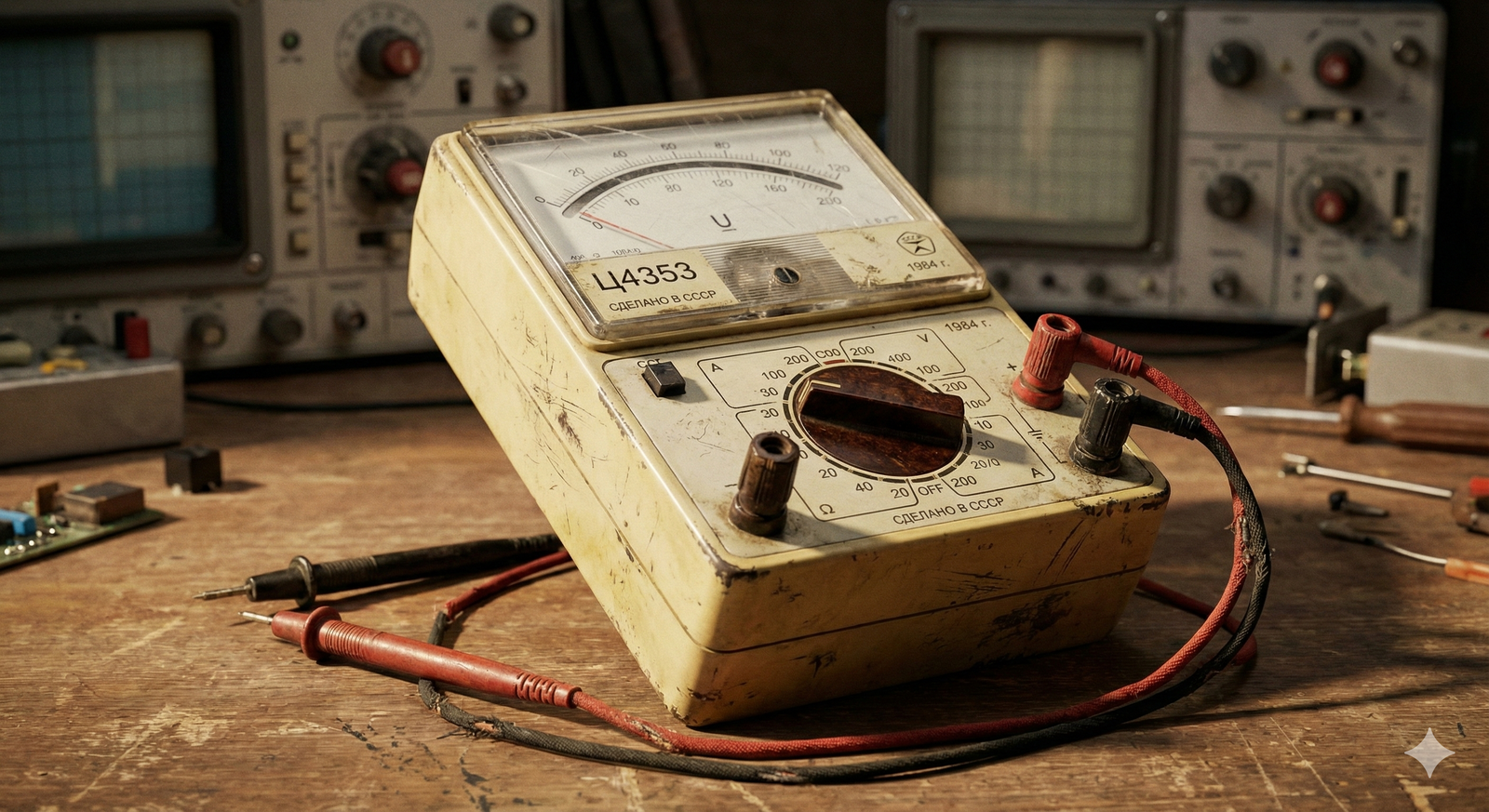
In the spirit of documenting my research tools, I present a review of my most reliable piece of equipment: the Ц4353 multimeter, manufactured in the Soviet Union circa 1984.
Acquisition
I acquired this multimeter in 1996 from a colleague who was retiring. He warned me that “the calibration is probably off, but it still works.” This turned out to be both accurate and an understatement.
Specifications (Theoretical)
According to the original documentation (which I still have, yellowed and water-stained):
- Voltage range: 0-1000V DC, 0-750V AC
- Current range: 0-10A
- Resistance range: 0-10MΩ
- Accuracy: ±2.5% (when new)
- Weight: Approximately 2 kg (feels heavier)
Specifications (Actual)
After 29 years of use:
- Voltage measurements: Surprisingly accurate (within ±5% compared to modern equipment)
- Current measurements: Optimistic by approximately 15%
- Resistance measurements: Creative
- Accuracy: “Sufficient for government work” (as we used to say)
- Weight: Still approximately 2 kg (definitely feels heavier than it used to)
Notable Features
1. Indestructibility This device has survived:
- Being dropped from a height of 1.5 meters (three times)
- Exposure to temperatures ranging from -25°C to +45°C
- Brief submersion in tea (2003, don’t ask)
- The collapse of the Soviet Union
It continues to function.
2. The Mysterious Third Position
The range selector has a position between the 10V and 100V settings that is not documented in any manual. When set to this position, the meter displays readings that are consistently 1.7 times higher than expected. I have no idea what this position is supposed to measure. I use it anyway.
3. Mechanical Charm
Unlike modern digital multimeters, the Ц4353 features a proper analog needle display. There is something deeply satisfying about watching the needle swing across the scale. It also makes a small clicking sound when you change ranges, which I appreciate.
4. Battery Life
The original battery (a 9V “Крона” type) lasted from 1996 to 2004. The replacement battery lasted from 2004 to 2011. The current battery has been in use since 2011. I am beginning to suspect the battery specifications were extremely conservative.
Quirks and Limitations
- The zero adjustment knob requires frequent tweaking
- Measurements taken on Tuesday mornings are consistently 3% higher than other days (I have not investigated this)
- The case has a persistent smell of old electronics and Soviet-era plastic
- The leads are original and show their age (I should replace them but I’m somewhat attached)
Comparison to Modern Equipment
I recently borrowed a modern digital multimeter from a colleague. Here are my observations:
| Feature | Ц4353 (1984) | Modern Unit |
|---|---|---|
| Accuracy | ±5% | ±0.5% |
| Boot time | Instant | 2 seconds |
| Battery life | Decades | 200 hours |
| Satisfying clicking | Yes | No |
| Historical value | Significant | None |
| Probability of working in 2055 | High | Low |
Conclusion
The Ц4353 is not the most accurate multimeter. It is not the most precise multimeter. It is arguably not even a properly functioning multimeter by modern standards.
But it is my multimeter, and it has been with me through countless experiments, measurements, and what my critics call “measurement errors” but I prefer to call “interesting data points.”
Rating: 7/10
- Would be 6/10 based on specifications
- +1 for sentimental value
- +1 for surviving the tea incident
- -1 for the Tuesday morning anomaly
Recommended for: Anyone who values reliability over accuracy, or who wishes to experience measurement technology from an era when “good enough” was, indeed, good enough.
Note: If anyone knows what the undocumented range selector position is actually for, please contact me. This has bothered me for nearly 30 years.