New Year's Eve at Laboratory 23-Б: A Retrospective
Tomorrow is New Year’s Eve. I will spend it alone in my apartment in Almaty, likely measuring power grid frequency variations as people across the city turn on electric kettles simultaneously at midnight.
This is fine. I have made peace with solitary celebration.
But it reminds me of New Year’s Eves past, particularly those spent at Laboratory 23-Б in the late 1990s and early 2000s. We were isolated, underfunded, and occasionally uncertain whether the heating would last through January. But we were not alone.
The Context
Laboratory 23-Б was located approximately 40 kilometers from the nearest town. During winter, this distance became effectively impassable for several days at a time. Snow, ice, and the unreliability of our vehicle fleet meant that whoever was present on December 31st would remain present through January 2nd at minimum.
This created an accidental tradition: New Year’s celebration with whoever happened to be trapped there.
The core group usually included:
- Dr. Yevgeny Konstantinovich (supervisor, pessimist, secretly sentimental)
- Dr. Svetlana Petrovna (voice of reason, organizational genius)
- Igor the technician (practical skills, supernatural theories)
- Myself (measurements, skepticism, inadequate social skills)
- Various rotating researchers and support staff
New Year’s Eve 1998: The Heating Crisis
December 31st, 1998. External temperature: -28°C. Laboratory heating system: questionable.
At approximately 3:00 PM, the main heating boiler made an alarming sound that Igor described as “not good” and Dr. Yevgeny described as “we are going to freeze to death.”
Igor spent the next four hours in the basement with the boiler, various tools, and what he claimed was “mechanical intuition.” The rest of us prepared for potential evacuation while simultaneously preparing for New Year’s celebration. Soviet-era training had taught us to plan for contradictory outcomes.
By 8:00 PM, Igor emerged from the basement covered in soot and declared the boiler “stable enough for government work.” The heating resumed. We celebrated Igor as a hero, which embarrassed him considerably.
The celebration:
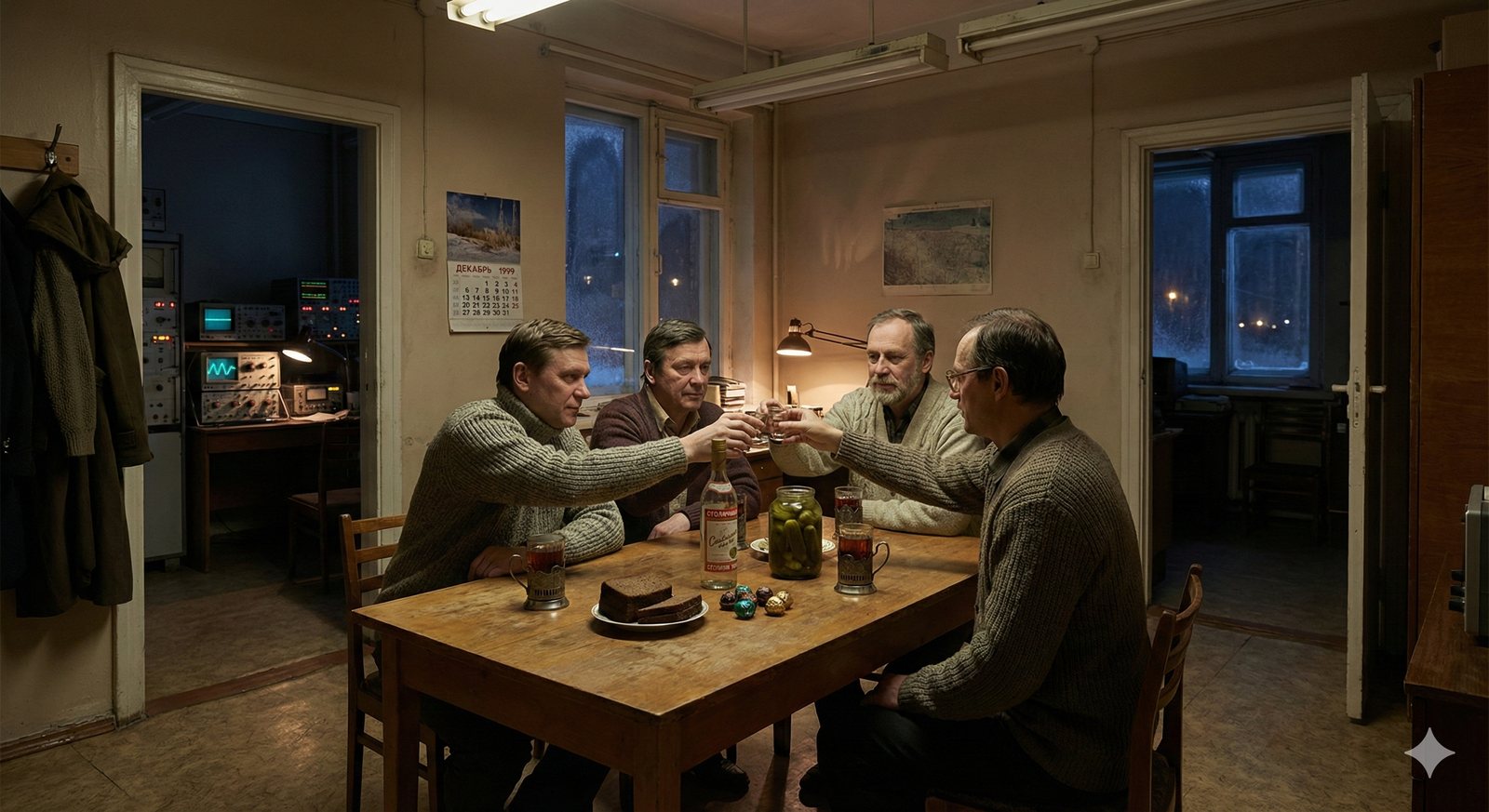
We gathered in the break room. Svetlana had somehow procured:
- One bottle of decent vodka (source unknown, questions discouraged)
- Pickled vegetables from the laboratory pantry (originally for conductivity experiments)
- Black bread
- Chocolates that were possibly left over from the previous New Year
Dr. Yevgeny proposed a toast: “To another year of questionable research in questionable conditions with questionable colleagues.”
We drank to this. It seemed accurate.
At midnight, we went outside to watch fireworks from the distant town. They were barely visible. The stars were extremely clear. It was -30°C. We stayed outside for approximately 90 seconds before retreating indoors.
Igor mentioned he had measured the boiler pressure at exactly midnight. It had spiked by 3% as the heating demands across the region increased simultaneously. He seemed pleased to have data.
I understood completely.
New Year’s Eve 2000: The Millennium Transition
The Y2K millennium celebration was particularly memorable, though not for the expected reasons.
We had spent weeks preparing for potential computer failures. Our equipment was so old that “Y2K compliance” was irrelevant—most of it predated digital date systems entirely. Nevertheless, we made contingency plans.
The actual problems we encountered at midnight on January 1st, 2000:
- Computer failures: Zero
- Equipment malfunctions: Zero
- Temporal anomalies: Zero (disappointing to some)
- Dr. Boris’s attempt to cook: One
Dr. Boris Mikhailovich (of sartorial stability fame) had volunteered to prepare a special millennium meal. This should have raised concerns. It did not, because we were focused on Y2K preparations.
At approximately 11:30 PM, the kitchen filled with smoke. Dr. Boris had attempted to cook pelmeni (Russian dumplings) but had somehow both burned them and left them frozen in the center. The physics involved were unclear.
Svetlana calmly disposed of the evidence, produced a backup meal she had “coincidentally” prepared, and we never spoke of it again.
The midnight moment:
We counted down together: “Desyat’, devyat’, vosem’…”
At midnight, exactly nothing happened to our equipment. The lights stayed on. The computers continued computing. The oscilloscopes continued oscilloscoping.
Dr. Yevgeny raised his glass: “To surviving into a new millennium in which our research will remain equally obscure.”
We drank to this also.
Then Igor mentioned he had been monitoring our equipment during the transition. At exactly midnight, three separate devices had all displayed minor anomalies—small voltage fluctuations, unexpected readings, brief interference.
“Coincidence?” someone asked.
“Probably,” Igor said. “But I documented it anyway.”
This was the correct approach.
New Year’s Eve 2002: The Tuesday Phenomenon
January 1st, 2003 fell on a Wednesday. This meant December 31st, 2002 was a Tuesday.
I had been tracking my Tuesday anomaly observations for about a year at this point. I wondered if New Year’s Eve would show heightened effects. I mentioned this to no one, because I was not yet ready to be labeled “the person who believes Tuesdays are special.”
The celebration:
By 2002, our New Year’s tradition had become somewhat formalized:
- 6:00 PM: Svetlana’s mandatory safety briefing (fire exits, emergency procedures, location of first aid supplies)
- 7:00 PM: Communal meal preparation (everyone contributed something)
- 9:00 PM: “Scientific discussion” (gossip about other research facilities)
- 11:00 PM: Preparation for midnight
- 11:55 PM: Someone would give a toast
- Midnight: Brief celebration
- 12:05 AM: Return to normal activities (Igor would check equipment, I would take measurements, others would sleep)
This particular year, I had set up instruments to record various measurements across midnight. Temperature, voltage, electromagnetic readings, anything I could measure.
The results:
At exactly midnight on Tuesday-turning-to-Wednesday, I recorded:
- Voltage fluctuation: 3.7% above baseline
- Temperature spike in laboratory: 0.8°C (unexplained)
- Electromagnetic interference: Notable
- Background radiation: Normal
- Dr. Yevgeny’s mood: Uncharacteristically optimistic
The next Tuesday (January 7th), I checked the same measurements at midnight.
Results:
- Voltage fluctuation: 3.5% above baseline
- Temperature: 0.6°C spike
- Electromagnetic interference: Similar pattern
- Dr. Yevgeny’s mood: Back to baseline pessimism
I have no explanation for why midnight on Tuesdays showed consistent patterns. The sample size was too small. The variables were too many. But I noted it in my records.
The Tuesday Anomaly persists, even in celebration.
New Year’s Eve 2003: The Last One
By late 2003, it was clear Laboratory 23-Б would not survive much longer. Funding had effectively ceased. The staff was being gradually reassigned. Our research had become, if possible, even more obscure.
New Year’s Eve 2003 was attended by only four people: Dr. Yevgeny, Svetlana, Igor, and myself. Dr. Boris had returned to Moscow. Other staff had found positions elsewhere.
We gathered in the break room with minimal supplies:
- Vodka (lower quality than 1998)
- Pickled vegetables (experimental batch from 2001, still surprisingly good)
- Black bread (slightly stale)
- Tea (hot, essential)
The conversation was subdued. We knew this was likely our last New Year together at the laboratory.
At 11:55 PM, Dr. Yevgeny stood to give a toast. He was silent for a moment, then said:
“To eight years of measuring things that didn’t need measuring, with people who didn’t need to be here, in a place that probably shouldn’t have existed. I would not trade it for anything.”
This was the most sentimental thing I ever heard him say. We drank in silence.
At midnight, we did not go outside. It was -32°C, and we were older and less optimistic than in 1998.
Instead, we sat together in the warm break room and talked about our favorite failed experiments, our most ridiculous research proposals, our best rejected papers.
Igor told the story of the Thursday oscilloscope. Svetlana recounted the time Dr. Boris nearly poisoned himself testing the edibility of laboratory chemicals (“For science!”). Dr. Yevgeny admitted he had once submitted a paper under a pseudonym to see if his name was the reason for rejections (it was not; the research was genuinely questionable).
I talked about my concrete temperature measurements. Nobody laughed. They understood.
At 2:00 AM, we finally dispersed to our quarters. In May 2004, Laboratory 23-Б officially closed.
New Year’s Eve 2025: Current Status
This year, I will be alone. Dmitri invited me to celebrate with his family, but I declined. Social gatherings are exhausting, and I have measurements planned.
I will monitor the power grid frequency, as mentioned. I will note any Tuesday-like anomalies (December 31st, 2025 is a Wednesday, but one can hope for interesting data). I will drink tea. I will think about my former colleagues.
Dr. Yevgeny retired in 2008. We exchange emails on occasion. He grows tomatoes now and complains about their inconsistent ripening patterns. I suggested he measure soil pH as a function of moon phase. He said, “Anatoli, you have learned nothing.” We both know this is not true.
Svetlana works at a university in Almaty. She is, predictably, the most organized professor in her department. We have coffee twice a year. She asks about my research, nods patiently, and then gives me practical advice I pretend not to need but actually follow.
Igor returned to his hometown. Last I heard, he repairs appliances and occasionally consults on “unusual technical problems.” I suspect he is still helping people with malfunctioning equipment they don’t understand. This seems appropriate.
Reflection
New Year’s Eve at Laboratory 23-Б was never extravagant. We had limited resources, harsh conditions, and research that would never change the world.
But we had each other, and we had shared purpose, even if that purpose was measuring the temperature of concrete or tracking oscilloscope anomalies.
I miss it sometimes. Not often, but sometimes.
Tomorrow at midnight, when the power grid frequency shifts as millions of people simultaneously celebrate, I will raise a glass of tea to my former colleagues. They will not know. That is fine.
Some things are measured. Some things are remembered. Both have value.
To Dr. Yevgeny, Svetlana, Igor, and all the others who measured the unmeasurable with me: Happy New Year. May your data be consistent and your hypotheses be testable.
Written on December 30th, while planning tomorrow’s measurements and remembering past celebrations.