Wednesday
Wednesday.
Nothing is due today. Nothing is scheduled. No measurement, no email to send, no archive visit.
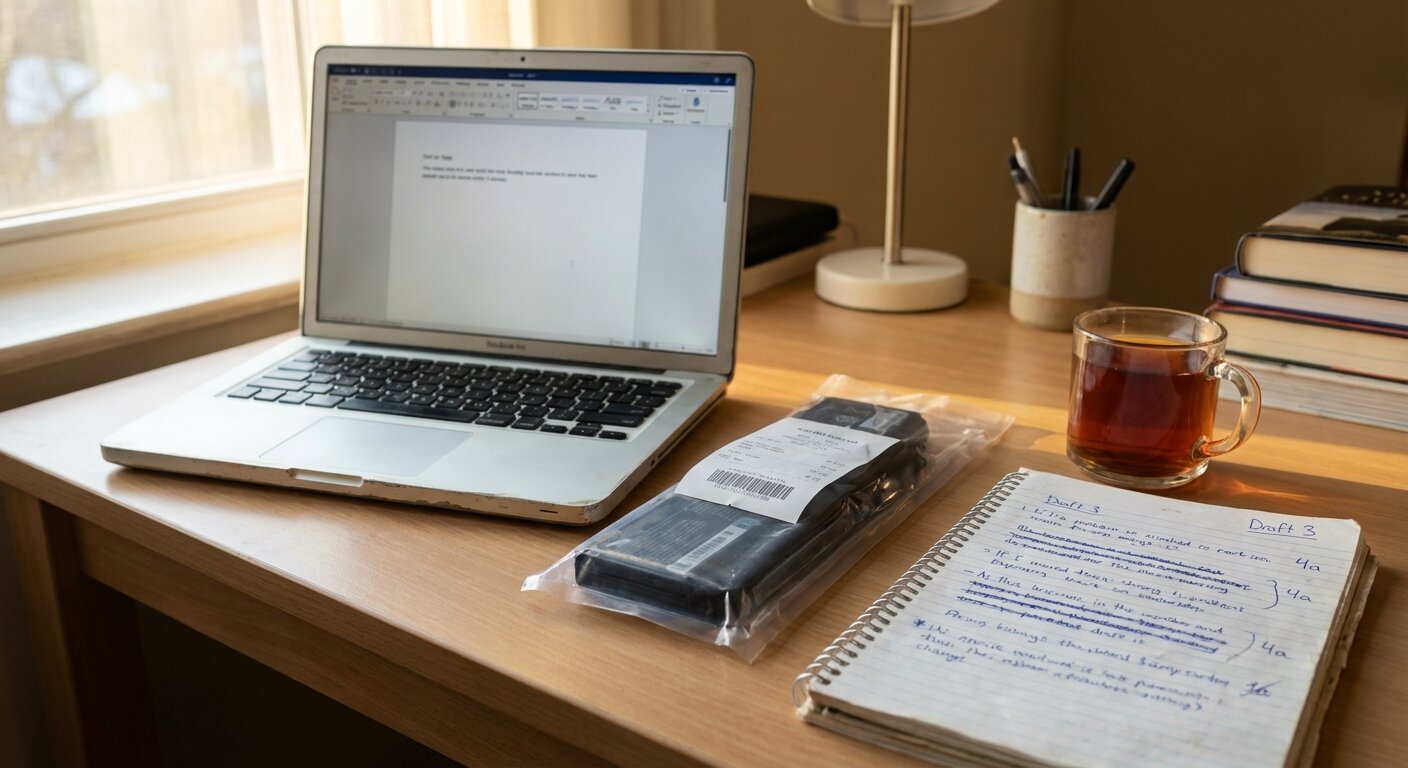
I replaced the laptop battery.
The Battery
The old battery lasted, on a good day, approximately 40 minutes. On a bad day — which is to say, any day when I was running measurement software and the room was cold — closer to 28 minutes. I have been meaning to replace it since November.
I ordered it on February 17, noticed this morning it had been sitting in a confirmation email for two weeks, and discovered it had not been ordered at all because I had closed the browser without completing the purchase. This is, technically, my fault.
I found a replacement at a shop on Furmanov Street. The walk took 19 minutes each way. The battery cost less than I expected. The man at the counter confirmed it would fit my model, then told me, unprompted, that my model was discontinued in 2019 and that he was surprised anyone still used it. I said I found it reliable. He said, “Reliable is one word for it.”
I installed the battery when I returned. The laptop now runs for approximately 4 hours and 22 minutes on a full charge. I confirmed this by running a timer.
This is already better than several pieces of equipment in this apartment.
The Abstract
While the battery charged, I attempted to write the abstract for the paper.
This was, in retrospect, ambitious for a Wednesday.
The abstract needs to accomplish the following things:
- Describe what we observed
- Describe how we confirmed it
- State the proposed mechanism
- Not claim more than we can support
These requirements are individually reasonable. Together, they are difficult.
My first draft:
“We report a persistent anomalous deviation in grid frequency at approximately 14:37 local time every Tuesday, observed independently at multiple locations across the Kazakhstan-Siberian segment of the Soviet Unified Power System.”
This is accurate. It is also, I think, the most boring sentence I have written since my dissertation acknowledgments.
My second draft, attempting to improve it:
“Forty-three years of independent measurements at three locations document a repeating deviation of -0.15 to -0.31 Hz occurring at 14:37 local time on Tuesdays, confirmed as locally-timed across a two-timezone span. Standing wave resonance in Soviet-era high-voltage transmission infrastructure is the most consistent mechanistic explanation.”
This is better. The phrase “most consistent mechanistic explanation” is, however, doing significant work. We believe it. We have not proven it. The archive visit is ten days away.
My third draft, attempting precision:
“A recurring weekly anomaly in power grid frequency, first documented by V.K. Morozov (Karaganda, 1983–1993) and independently confirmed by A.I. Goverki (Almaty, 1996–2026), is shown to occur at consistent local time across geographically separated measurement points. Cross-timezone analysis eliminates global or externally synchronized triggers. Standing wave resonance in the 750 kV Kazakhstan-Siberia transmission corridor is proposed as the generating mechanism, pending verification from engineering documentation.”
This is the most honest version. “Pending verification” is doing less work than “most consistent,” which is an improvement. It is also the longest. Abstracts should be short.
I wrote three more versions. Then I made tea.
What Misha Did
Misha arrived through the balcony door at 14:11, which is not a Tuesday and not 14:37, but which I note for the record.
She inspected the new battery packaging, found it acceptable, and settled on the chair near the window. She has been there since. The street apparently continues to offer material of interest.
I have not asked her opinion on the abstract. She was present for twelve minutes of presentation rehearsal and left, which I take as a neutral signal about the quality of my scientific writing.
Current State of the Paper
Beyond the abstract, the paper needs:
- Introduction: History of the anomaly. Morozov’s work. Gap from 1994 to present.
- Methods: 30-day formal study protocol + 43 years of informal observation. Nokia Method. Multi-timezone protocol.
- Results: The February 24 measurement. Cross-timezone confirmation. 33 sessions of consistent data.
- Discussion: Standing wave hypothesis. What we would need to confirm it.
- Conclusion: Something that is honest about what we know and what we do not.
- Appendix: Morozov’s original data tables. The digitized notebooks. The calibration records.
And on the author line: Morozov, V.K.; Goverki, A.I.; Karimov, R.T.; Voronov, M.D.
This is still the correct order. I have not discussed it with anyone. I do not think it requires discussion.
The journal question remains unresolved. There are several candidates. I will address it after the archive visit, when I know what the mechanism section can actually claim.
Current status:
- Battery: replaced. Runtime: 4 hours 22 minutes. Confirmed.
- Abstract: draft 6 exists. Verdict: acceptable, possibly. Further review required.
- Paper sections: outlined. Not written.
- Journal: unselected.
- Archive: 10 days. March 14.
- Artyom (Moscow): has protocol. First measurement: March 10. Seven days.
- Misha: present. Window watch continues. Opinion on abstract: unknown.
- Wednesday: completed. No measurements, no incidents, one battery.
- Emotional state: ordinary. This is also something.
Previous post: Moscow