Three Boxes, Thirty-Nine Years
She opened the door before we knocked.
“I saw the taxi from the window,” Valentina Sergeevna said. “You look younger than you sound on the telephone.”
“I am 52,” I said.
“That is young.” She stepped aside. “Come in. Both of you. Remove your shoes. The floor is cold, I will bring slippers.”
The Apartment
Her apartment smells like old books and lavender. The hallway is narrow, lined with bookshelves - not decorative, but the kind that accumulate over decades because nobody stops buying books. Many of them are technical. I saw titles in Russian on power engineering, electromagnetic theory, atmospheric physics. Viktor Morozov’s library, still in place.
The living room is small and warm. A radiator clicks in the corner. Photographs everywhere - on walls, on shelves, on the television that looks like it has not been turned on in years. Viktor in most of them. A tall man with dark hair and serious eyes. In one photograph, he is standing in front of a building I recognize from our walk yesterday: the Institute of Geophysics, before it became FAST FIX.
Valentina brought tea in glasses with metal holders. Podstakanniks. The old kind, heavy, with engravings.
“Viktor’s,” she said, noticing me looking at them. “He said tea tastes different in proper holders. I never agreed, but I kept them.”
Ruslan accepted his tea with both hands and said nothing. I have learned that Ruslan’s silence means he is paying attention.
Borya
Then I noticed the cat.
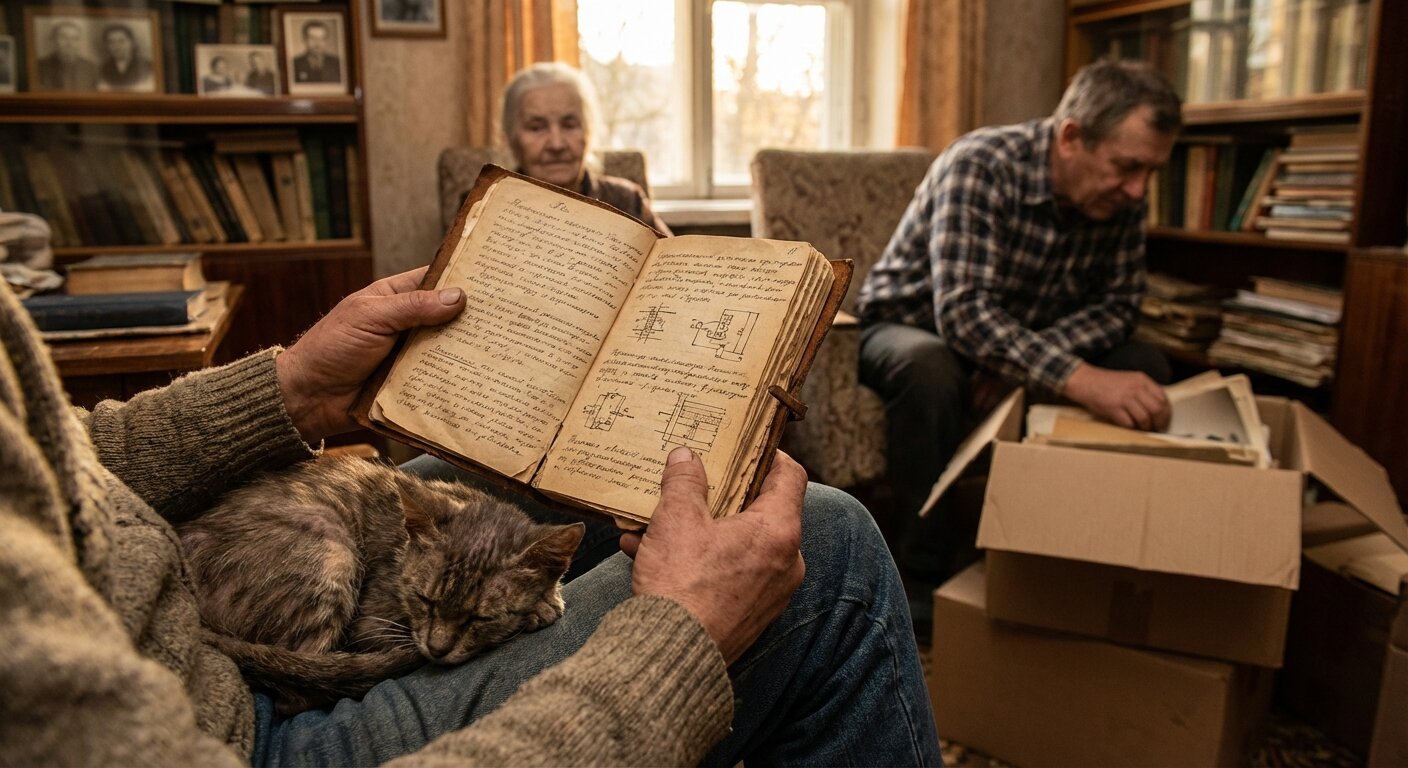
On a chair in the corner, barely distinguishable from the cushion, a very old cat was watching us. His fur was the color of dust - grey-brown, thin in places, with the texture of something that has been alive for a very long time. His eyes were amber and cloudy at the edges.
“That is Borya,” Valentina said. “He is nineteen.”
“Nineteen,” I repeated.
“He was Viktor’s cat. Well. He was a kitten when Viktor died. So he is mine now. But he was Viktor’s first.”
Borya did not move. He watched us from his chair with the patience of something that has seen everything and decided most of it was not worth getting up for.
“He does not like strangers,” Valentina said. “Do not take it personally.”
I did not take it personally. I sat on the sofa and focused on the tea.
Box One: The Protocols
Valentina disappeared and returned with a cardboard box. It was brown, slightly crushed on one side, with Cyrillic writing in marker: “В.К.М. - ИЗМЕРЕНИЯ 1983-1987” (V.K.M. - MEASUREMENTS 1983-1987).
“This is the first one,” she said. “The measurements.”
I opened it with hands that were not entirely steady.
Inside: notebooks. Eleven of them, numbered, each labeled with date ranges. The handwriting was small, precise, consistent. Viktor Morozov wrote the way I write - every data point recorded, every timestamp exact, every anomaly noted.
I opened notebook number 7 (March-June 1986) at a random page.
| Date | Time | Frequency (Hz) | Deviation | Pressure (mbar) | Day |
|---|---|---|---|---|---|
| 12.03.86 | 14:35 | 49.97 | -0.03 | 1013.2 | Среда (Wed) |
| 18.03.86 | 14:36 | 49.82 | -0.18 | 1015.7 | Вторник (Tue) |
| 19.03.86 | 14:37 | 50.01 | +0.01 | 1015.4 | Среда (Wed) |
| 25.03.86 | 14:38 | 49.78 | -0.22 | 1012.8 | Вторник (Tue) |
| 26.03.86 | 14:35 | 50.03 | +0.03 | 1012.6 | Среда (Wed) |
I stopped breathing.
Tuesday. Tuesday. Tuesday.
The same pattern. The same time window. The same magnitude of deviation.
Thirty-nine years ago.
Ruslan leaned over my shoulder. He said nothing. He did not need to.
Box Two: The Correspondence
The second box was lighter. Valentina set it down with a different expression. Harder.
“This one you should read carefully,” she said. “It will make you angry.”
Letters. Dozens of them. Carbon copies of Viktor’s outgoing correspondence and originals of the responses.
A letter to the Institute director, requesting additional equipment for extended measurements. Response: “Your current project scope does not justify additional expenditure.”
A letter to the Academy of Sciences, proposing a multi-site observation study. Response: “The committee finds insufficient theoretical basis for the proposed phenomenon.”
A letter to a colleague in Moscow, asking if similar deviations had been observed in European grid data. Response: “Dear Viktor, I think perhaps you are working too hard. Have you considered a holiday?”
A letter to the journal editor, responding to reviewer comments on his paper. Draft after draft, each more restrained than the last. In the margin of the third draft, in pencil, barely legible: “Они не хотят знать.” (They do not want to know.)
Ruslan picked up the rejection letter from the Academy. He read it twice. He put it down and drank his tea in one long swallow.
“I told you it would make you angry,” Valentina said.
Borya
Somewhere during the second box, while I was reading Viktor’s third letter to the journal editor, something landed on my lap.
It was Borya.
He had crossed the room - I had not noticed, nobody had noticed - and jumped onto my lap with the slow, deliberate effort of a very old animal using the last of something precious. His joints were stiff. His landing was graceless. He weighed almost nothing.
He turned once, twice, and settled.
I looked at Valentina. She had stopped moving.
“He has not done that since Viktor,” she said quietly.
I did not know what to say. The cat was warm on my legs. His breathing was slow and shallow. Nineteen years old. He had been a kitten in this apartment when Viktor Morozov was alive and measuring frequencies that nobody believed in.
I put my hand on his back. His fur was thin. I could feel his ribs. He purred - not loudly, just a faint vibration, like a frequency you have to concentrate to detect.
Ruslan looked at me. I looked at the box of rejection letters. The cat purred on my lap.
I am not a person who cries easily. I have not cried since Dr. Volkov’s letter. But in that moment, in an apartment in Karaganda, with a dead man’s cat on my legs and a dead man’s failures in my hands, something shifted.
“I am sorry,” I said. I do not know who I was apologizing to. Viktor. Borya. Valentina. The frequency that nobody measured for thirty-nine years.
“Do not be sorry,” Valentina said. “Be the one who finishes it.”
Box Three: The Notebook
The third box was the smallest. Inside: a single notebook. Black cover, no label.
“I do not know what this one is,” Valentina said. “I never opened it. It was in his desk when he died. Separate from the others.”
I opened it.
The first page, in Viktor Morozov’s handwriting:
“Заметки для того, кто найдёт это после меня.” (Notes for whoever finds this after me.)
The room was silent.
The notebook contained Viktor’s personal observations. Not data - those were in Box One. This was something else. His thoughts. His doubts. His theory, unfinished, about what might cause the Tuesday deviation. References to papers he had read. Questions he could not answer. Diagrams drawn late at night.
The last entry was dated November 3, 1993. Thirteen months before his death.
“I have measured this phenomenon for eleven years. I believe it is real. I believe it is significant. I do not have enough data to prove it and I will not be given the resources to collect more. If someone reads this: measure Tuesdays. 14:30-14:45 local time. The grid remembers something that we have forgotten. I do not know what it is. But it is there. Every week. Without fail.
Do not let them tell you it is noise. Noise does not keep a schedule.
V.K.M.”
Borya purred on my lap.
I closed the notebook and held it for a long time.
Leaving
We stayed until 19:00. Valentina fed us soup and bread. She told us about Viktor - how he would wake at 5:00 to check his instruments, how he once drove to Astana in a blizzard because his barometer readings suggested something interesting, how he kept measuring even after the funding was cut, using his own money, his own time, his own stubbornness.
“He sounds like someone I know,” Ruslan said, looking at me.
“He sounds like several people I know,” I said, looking at Ruslan.
Valentina packed the three boxes for us. She wrapped them in plastic bags against the snow.
“Take them,” she said. “They have been waiting long enough.”
At the door, Borya had returned to his chair. He watched us leave with the same amber eyes.
“Will you come back?” Valentina asked. Not demanding. Just asking.
“Yes,” I said. “When we have results.”
“Viktor would have liked you,” she said. “Both of you. He always said the right people would come eventually. I thought he was being optimistic. He was never optimistic about anything else.”
The Hotel
It is 21:30. We are in the hotel room. The three boxes are on the floor between our beds. The lamp still flickers at approximately 3 Hz.
Ruslan is reading notebook number 1 (1983-1984). He has not spoken in forty minutes.
I am holding the black notebook. Viktor’s last notes. Addressed to me, though he did not know my name.
Measure Tuesdays.
I have been measuring Tuesdays for thirty years, Viktor. I did not know you were measuring them too.
Tomorrow we take the train home. We have three boxes of data, eleven notebooks of measurements, a folder of rejection letters, and the personal notes of a man who died waiting for someone to listen.
I will not let this be noise.
Borya purred on my lap today. Nineteen years old. He remembered something. Cats do not understand physics, but perhaps they understand persistence.
Current status:
- Boxes retrieved: 3 of 3
- Notebooks: 11 (measurement protocols, 1983-1987)
- Letters: ~40 (correspondence, rejections)
- Personal notebook: 1 (Viktor’s final notes)
- Viktor’s last measurement: November 3, 1993
- Cat on lap: 1 (Borya, 19 years old)
- Times I almost cried: 2
- Times I actually cried: I will not answer this
- Return train: Tomorrow evening
- Promise made: To finish what Viktor started
Previous post: Karaganda