Notebook Eleven
I finished digitizing Morozov’s notebooks this afternoon.
1,102 pages. Eleven notebooks. Photographs, typed transcriptions, cross-references. The last photograph was taken at 16:43. I noted the time.
Notebook Eleven is different from the others.
The First Ten
Notebooks One through Ten are measurement records. Dates, times, frequency values, atmospheric pressure, temperature, notes on equipment behavior. Viktor’s handwriting is small and consistent. The data tables are immaculate. Occasionally there is a margin note — a question, an observation, once a small drawing of what I believe is Borya as a kitten sleeping on the desk.
These notebooks are the foundation of what we are building. They are Viktor’s contribution to a dataset that spans 43 years. They are the reason Morozov will be listed as first author.
I have read all of them. I have not retained all of them. Some of this material will take months to fully process.
Notebook Eleven begins with measurements, as expected. January through April 1993. Then something changes.
The Shift
In May 1993, the measurements become sparse. Weekly instead of daily. Viktor was, by this point, six years into working without funding. I do not know what else was happening in his life in May 1993.
But starting on page 891, the notebook changes character entirely.
Viktor stopped recording measurements. He started theorizing.
The pages in this section are different — not tables, but paragraphs. Diagrams. The handwriting is slightly less controlled, as if he was writing faster than usual. These pages feel urgent in a way the measurement notebooks do not.
He was trying to find the mechanism.
What He Found
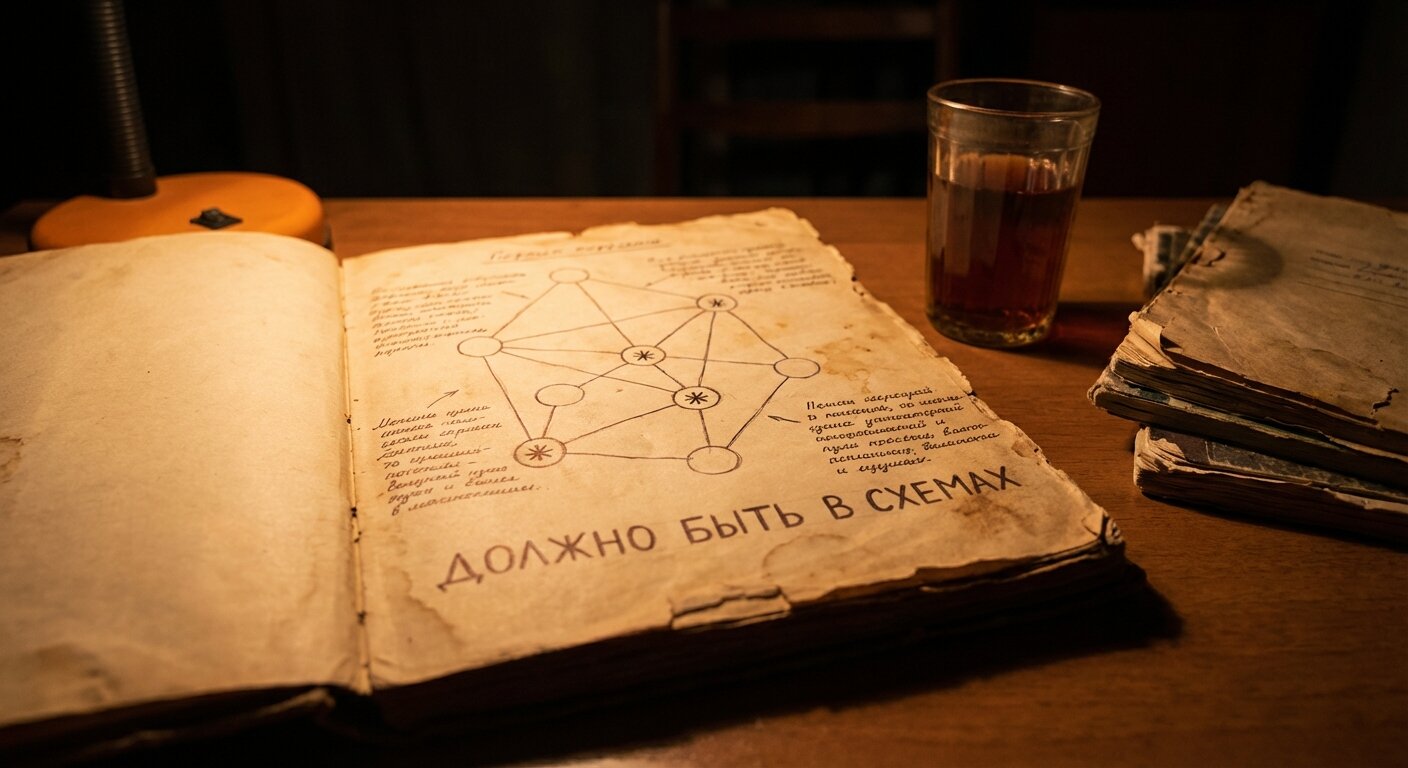
On page 894, Viktor drew a diagram.
It is a network diagram — not a schematic, but a topology map. He sketched the rough structure of the Soviet Unified Power System: generating stations, transmission corridors, regional substations, distribution nodes. The lines connect regions I recognize: Karaganda, Almaty, Novosibirsk, further west. The whole continental grid, reduced to circles and lines on a notebook page.
At three points on the diagram, he drew small asterisks. One near Karaganda. One near a transmission corridor running northeast. One I cannot place precisely — somewhere between the Urals and western Siberia.
Below the diagram, he wrote: “Резонансные узлы? Если да — частота определяется длиной линии.”
“Resonance nodes? If so — the frequency is determined by the length of the line.”
He was thinking about standing waves. Long-distance transmission lines have physical length. At 50 Hz, the wavelength of an electromagnetic wave is 6,000 kilometers. A transmission line of a specific length can act as a resonator — it has natural resonant frequencies that depend on its physical dimensions. If something drives the system at or near one of those frequencies, you get an anomaly.
The Soviet Unified Power System had transmission lines spanning thousands of kilometers.
Viktor had found a plausible mechanism.
What He Did Next
On page 897, there is a list of ГОСТ document numbers. ГОСТ — Gosudarstvennyy Standart — the Soviet state engineering standards. Viktor had written down six document numbers and partial titles:
- ГОСТ 13109-67: Электрическая энергия. Нормы качества… (Power quality standards)
- ГОСТ 19431-84: Энергетика и электрификация… (Grid terminology)
- Four others I could only partially read — the ink was faded.
Below the list, in larger handwriting than anywhere else in all eleven notebooks:
“Должно быть в схемах.”
“It must be in the schematics.”
That is the last entry related to the theory. Two pages later, the notebook ends. There are twelve blank pages after that.
Viktor died in February 1994. He wrote this in autumn 1993, at most five months before the end.
He knew where to look. He did not have time to look there.
What This Means
I sat with notebook eleven for a long time after I photographed the last page.
Then I sent a message to Ruslan.
Then I called Mikhail — which is not something I do on a Thursday, or, if I am honest, on most days. He answered on the second ring. I told him what I had found. I read him Viktor’s diagram description and the ГОСТ list.
There was a pause.
“Standing waves,” Mikhail said. “Of course. The line lengths.”
Mikhail studied transmission physics. I had forgotten this.
“If the resonance nodes are at fixed geographic points,” he said, “and those points happen to fall within UTC+5 and UTC+7 grid regions — the anomaly would appear at the same local time because the driving force is the same physical structure, not a scheduled event.”
“Yes,” I said.
“And 14:37 would be when load conditions align with the resonant frequency.”
“That is what I think Viktor was concluding, yes.”
Another pause. Then Mikhail said: “You need the original schematics. The Soviet grid documentation. Physical line lengths, substation positions.”
I know. I know exactly what I need.
Here is what I also know: Soviet engineering standards are archived. The Russian State Archive of Scientific and Technical Documentation exists. The Kazakhstani equivalents exist. Some of this material has been digitized. Some has not. Some may be accessible to a retired physicist who writes politely and explains clearly why he is asking.
I have written 17 papers in my career. Three citations. I have submitted to fourteen journals and been rejected by twelve. I have spent thirty years measuring things that nobody asked me to measure.
I have never had a lead this specific before.
Viktor pointed at a shelf. He did not have time to open it. I have the shelf coordinates. I have a team of people who understand why this matters. I have 43 years of data that says something is there.
I am going to find the schematics.
Current status:
- Morozov digitization: complete. 1,102 pages, 11 notebooks, 16:43 on a Thursday.
- Notebook Eleven: Viktor’s theoretical work. Standing wave hypothesis. Resonance nodes. ГОСТ references.
- Viktor’s last theoretical note: “It must be in the schematics.”
- New direction: Soviet grid documentation. Archive research begins.
- Mikhail: “Of course. The line lengths.” He understood immediately.
- Ruslan: has already opened a twentieth tab in the spreadsheet. It is called “Schematics.”
- Emotional state: I am going to find the schematics.
Previous post: The New Question