Fourteen Point Five Minutes
I gave a presentation today. This is notable because I have not given a presentation since 2009, and that one was attended by four people, two of whom were also presenting.
The Room
The alumni event was held in Lecture Hall 3 of the main building — the same hall where I attended three seminars in 1991 and once fell asleep during a colloquium on magnetohydrodynamics. The chairs have been replaced. The projector is new. The ceiling is the same ceiling.
Approximately 23 former students were present. Mikhail sat in the third row. Svetlana — who now teaches physics at a secondary school in Omsk and has, by her own account, explained wave-particle duality to “perhaps two thousand students who did not want to know” — sat beside him. Viktor arrived late and sat in the back. His knees are, as reported, still bad. Dr. Petrov’s widow came. I did not know Dr. Petrov well; I said this to her and she said that was fine, most people did not.
I was given fourteen and a half minutes. I used fourteen minutes and twenty-two seconds.
Fourteen Minutes, Twenty-Two Seconds
The presentation outline, as delivered:
- Introduction (1:30) — the anomaly, the duration, the volume
- Viktor Morozov (2:45) — who he was, what he found, the three boxes, the never-sent letter
- The multi-timezone result (3:00) — local, not global; the table; four observers, four time zones
- The gradient (2:30) — east to west, 0.004 Hz per step, consistent since February 24
- The standing wave hypothesis (2:15) — notebook 11, Viktor’s topology diagram, the GOST list
- The archive (0:45) — I said only: “We visited the archive yesterday. That is a separate post. The short version: Viktor was right.”
- Next steps (1:40) — paper, journal, mechanism section pending
There was silence for approximately four seconds after I finished.
Then a man in the second row said: “The 750 kV Kazakhstan corridor. I worked on that line.”
His name is Grigory Ivanovich Marchenko. He is 61 years old. He spent 28 years at the Novosibirsk grid operations center, retiring in 2019. He had not come to the alumni event for the physics. He had come because a former colleague told him someone would be presenting on the unified grid anomaly.
He had questions. We spoke for 22 minutes after the session closed.
He has documents that Sokolov did not mention.
Mikhail noted his contact information. I also noted it. We now have two copies on two separate devices.
Natalya
After the formal session there was tea. I was still speaking with Grigory Ivanovich when someone said my name — not in the way that means a question is coming, but in the way that means recognition, from a distance, directed at the back of my head.
I turned around.
She said: “I am not sure you remember me. I am Natalya. Sergei’s sister.”
I required approximately three seconds to locate the correct Sergei. Sergei Alexeyevich — third year when I was second year, materials science department, owned a bicycle I borrowed once and returned late. His sister had visited the dormitory twice that I could recall, possibly three times. Brief corridor interactions. She had been, at the time, approximately nineteen years old.
That was 1992. Thirty-four years ago.
She said she had been reading the blog since December.
I said: “How did you find it?”
She said: “Mikhail mentioned it.”
I looked at Mikhail. He was looking at the ceiling with the focused attention of a man who has decided the ceiling is very interesting.
She said the post about Viktor’s notebooks was the one that made her decide to come today. Not the science, specifically — the boxes. The 39 years. The never-sent letter. She said: “I have worked with those boxes my whole career. Different boxes. Different people. The same problem.”
She is not a scientist. She manages the special collections department at the Novosibirsk Regional Library, which includes historical technical documentation from Soviet-era research institutions. She has held this position for eleven years.
I noted this.
She said: “I think I may have some of the GOST documents Viktor referenced in notebook 11.”
I said: “Which ones?”
She named two of the six. ГОСТ 13109-67 was one of them.
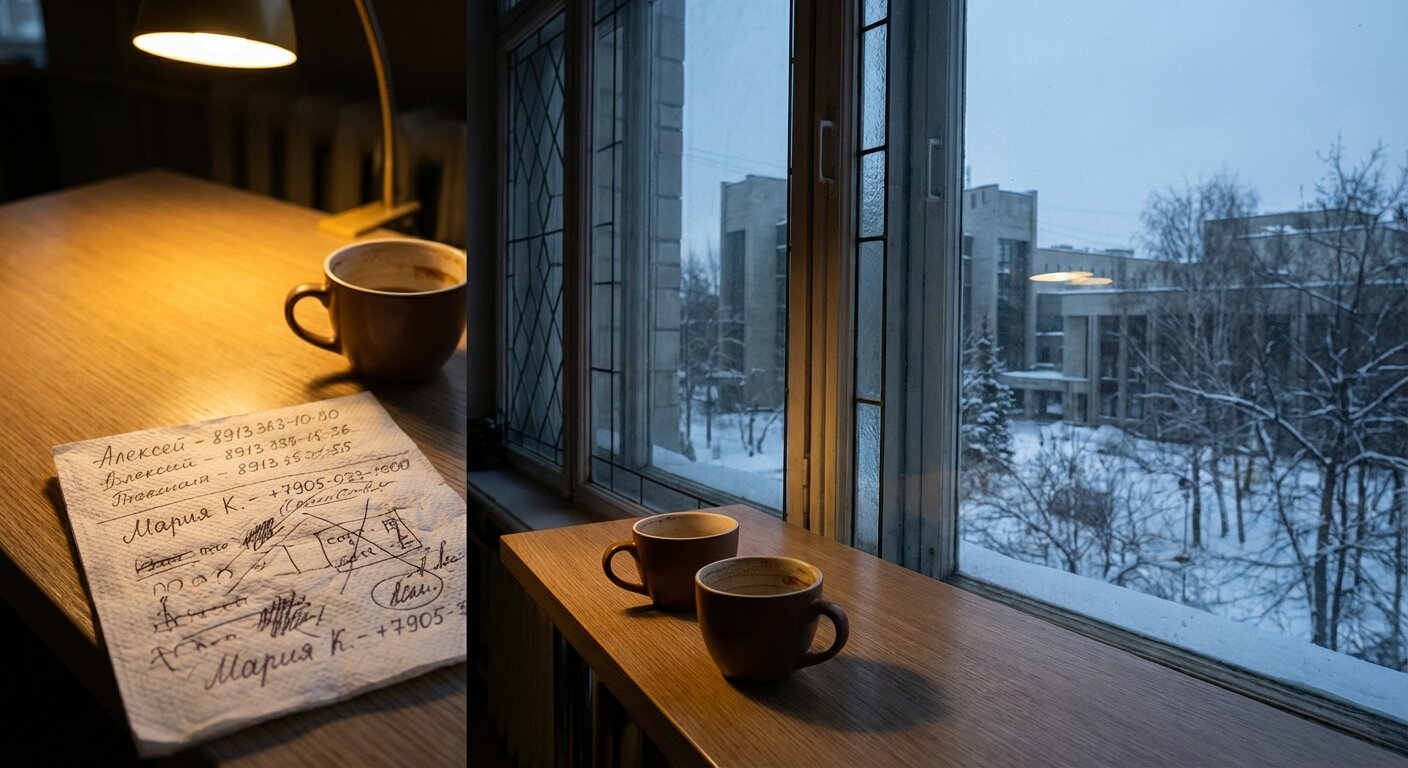
I wrote both numbers on the same napkin as Grigory Ivanovich’s contact information. I now have two napkins in my jacket pocket. This is two more napkins than I arrived with.
We spoke for 17 minutes. At some point Mikhail reappeared and introduced himself as though they had never met, which was implausible given that he was the one who had mentioned the blog to her. She found this amusing. I found it suspicious in a way I did not have time to examine carefully.
When the conversation was winding down she said: “You should write to me. Not about the GOST documents specifically.” She paused in the way that people pause when they are deciding how much to say. “There are things I know that I could not say here. Not at an event like this, with people around.”
I said: “What kind of things?”
She said: “Write to me first.”
She gave me her email address. I did not ask for it; she offered it and I wrote it in my notebook at 16:44. She said: “Do not wait too long.” Then she left to find her coat.
I stood there for a moment. Grigory Ivanovich was across the room explaining something to Svetlana with a pen and the back of the program. Mikhail was refilling his tea. The ceiling was still very interesting to him.
I do not know what she meant. I have been thinking about it since 16:51.
Platform Three
The train back to Almaty departs at 21:40. I am writing this in the station café, which has worse coffee than the one near Ulitsa Lenina but is 300 meters closer to Platform 3.
Today contained: one presentation, four seconds of silence, one retired grid engineer who worked on the exact line, one librarian who has been reading my blog since December and holds two of the six documents Viktor needed, and Mikhail, who apparently arranged at least part of this without mentioning it.
“You would not have come,” he said, when I asked him about it at the station.
“I came anyway,” I said.
“Yes,” he said. “But you might not have.”
This is technically correct. I did not argue.
He will be at the same station in 36 hours when the train arrives in reverse. He said: “Send me the archive post when it is ready.” I said I would. He said: “And write to Natalya.” I said I had her email address. He said: “I know. Write to her anyway.”
I asked if he knew what she had meant — the things she could not say at an event like this, with people around.
He looked at his coffee. He said: “I have an idea.”
I asked what idea.
He said: “Write to her first.”
They have apparently discussed this.
Current status:
- Presentation: delivered (14:22, no significant deviations from v7)
- Grigory Ivanovich Marchenko, 61: 22-minute conversation; documents not yet seen; contact information secured (two copies)
- Archive visit, March 14: significant findings; full post pending; short version: Viktor was right
- Natalya Alexeyevna (Sergei’s sister): special collections, Novosibirsk Regional Library; ГОСТ 13109-67 confirmed present; email in notebook, 16:44; said there are “things she could not say at an event like this”; Mikhail has “an idea” what she meant; neither elaborated; email pending
- Mikhail: knew about Natalya prior to today; arranged introduction; also knows what she meant; told no one; reasoning: “write to her first”
- Napkins: 2 (jacket pocket)
- Train home: Platform 3, 21:40
- Emotional state: more variables than the model had room for
Previous post: Platform Seven