On Accidental Eavesdropping and the Persistence of Analog Communication
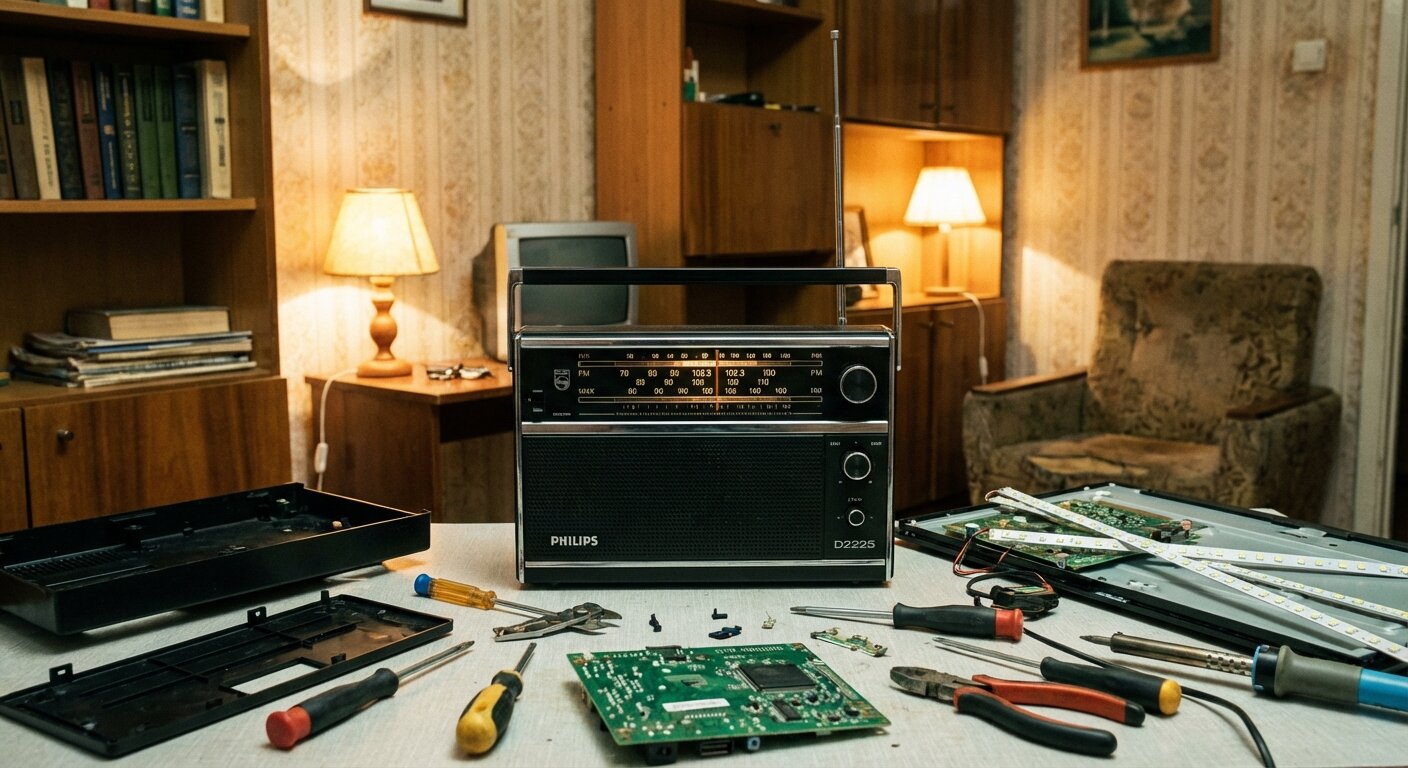
This afternoon I attempted to disassemble my deceased television (see previous post regarding premature capacitor failure). The process requires concentration, precision, and approximately 40 small screws of varying thread patterns. To maintain morale during this tedious process, I turned on my radio.
This is when I discovered that I am, apparently, eavesdropping on Almaty’s taxi drivers.
Initial Observations (13:15-13:47)
The radio was tuned to 102.3 FM, a station that plays a combination of:
- 1980s Soviet pop music (40%)
- Modern Kazakh music (30%)
- Advertisements for furniture stores (25%)
- Weather reports (5%)
However, beginning at approximately 13:22, I began hearing voices overlaid on the music. Not clearly, but distinctly present. Two men discussing something about “Abai Avenue” and “near the university.”
My first hypothesis: The radio is malfunctioning.
My second hypothesis: The furniture store advertisements have become extremely specific.
My third hypothesis (correct, as it turned out): Unintentional radio frequency interference.
Methodology for Investigating Mysterious Voices
I did what any reasonable person would do: I stopped disassembling the television and spent the next hour documenting the phenomenon.
Equipment:
- Philips portable radio (model unknown, purchased 2011)
- Notebook for transcription
- Tea (essential for concentration)
- Patience (variable supply)
Procedure:
- Adjusted antenna orientation (12 different positions tested)
- Varied volume levels
- Tested adjacent frequencies (102.1, 102.5, 102.7 FM)
- Documented time, content, and clarity of interference
Results:
Between 13:22 and 14:30, I documented 27 separate voice transmissions. Sample excerpts:
- “Taxi 47, pickup at Dostyk Plaza, going to airport”
- “Traffic jam on Rozybakiev, suggest alternate route”
- “Station 3, where is nearest fuel? Need to refill”
- “Police checkpoint on Seifullin, avoid if possible”
- “Has anyone been to the new KazMunayGas on Tole Bi? Prices?”
The pattern became clear: These are taxi radio communications. Specifically, they appear to be using a frequency very close to 102.3 FM, causing interference during transmission.
Technical Analysis: Why Taxis Use Analog Radio in 2026
This requires explanation. We live in an era of smartphones, GPS tracking, and mobile applications. Why would taxis use radio technology that is, conservatively, 60 years old?
After consideration (and one phone call to a taxi company, claiming to be a “concerned citizen with a technical question”), I have determined the following:
Advantages of analog radio for taxi dispatch:
-
Reliability: No signal dropout in underground passages or between buildings. Radio waves are simple. They propagate. They do not require 4G coverage or Wi-Fi.
-
Cost: One radio transmitter, multiple receivers. No monthly data plans. No smartphone contracts. No SIM cards that expire. Equipment lasts decades.
-
Simplicity: Press button, speak, release button. This is the complete user manual. No apps to update. No passwords to forget. No “have you tried restarting it?”
-
Broadcast capability: One message reaches all drivers simultaneously. Efficient for traffic updates, police checkpoint locations, fuel prices.
-
Maintenance: When Soviet-era radio breaks, you open it and replace a component. When smartphone breaks, you buy a new smartphone.
Disadvantages:
-
Privacy: Apparently, anyone with a radio can listen. Including physicists disassembling televisions.
-
Security: Transmissions are completely unencrypted. I now know where 27 different taxis were going this afternoon.
-
Professionalism: One driver spent four minutes complaining about his mother-in-law’s cooking. This was broadcast to entire fleet (and to me).
-
Frequency allocation: Using frequencies near FM radio band causes interference. This is probably not legal.
On the Ethics of Accidental Eavesdropping
I have stumbled into an interesting ethical question: If you accidentally overhear private communications because someone is broadcasting on an improper frequency, are you obligated to:
A) Report this to telecommunications authorities B) Inform the taxi company C) Stop listening D) Document the phenomenon for scientific purposes E) Continue disassembling your television and pretend you heard nothing
I am leaning toward option E, with elements of option D.
My reasoning:
Against reporting to authorities:
- The taxi system appears to function effectively
- Drivers are receiving useful real-time information
- Replacing analog radio with smartphones would be expensive and less reliable
- I am not personally harmed by knowing about traffic on Rozybakiev Street
Against informing taxi company:
- They almost certainly know their radio frequency is non-standard
- They have chosen this arrangement deliberately
- My phone call this morning was answered with: “We use radio. Is there a problem?” (There was suspicion in his voice. I said no, thank you, and hung up.)
Against stopping listening:
- This is fascinating data about informal communication systems
- I am learning about Almaty traffic patterns
- One driver recommended a bakery on Auezov that I have been meaning to try
In favor of documentation:
- Scientific curiosity
- This is an example of technological persistence in the face of “progress”
- Analog systems continue to outperform digital systems in specific applications
- Someone should record this before it disappears
Observations on Privacy in an Age of Encryption
There is something refreshing about the complete lack of privacy in taxi radio communications. Nobody is pretending these conversations are secure. Nobody is claiming encryption. It is simply assumed that:
- Most people do not listen to radio anymore
- Therefore, broadcasting in the open is functionally private
- This assumption appears to be correct
In Soviet times, we assumed everything was monitored (see my earlier post on surveillance). Privacy was achieved through:
- Speaking quietly
- Using vague language
- Assuming listeners but proceeding anyway
Modern digital communication claims to be private:
- End-to-end encryption
- Secure messaging apps
- VPNs and anonymization
But this privacy is conditional on:
- Trusting the software
- Trusting the service provider
- Trusting that there are no backdoors
- Trusting that your password is secure
Taxi drivers have achieved privacy through a different method: obsolescence-based security. They use technology so old that nobody is monitoring it anymore. Everyone is watching the internet. Nobody is listening to FM radio interference.
This is perhaps not intentional security strategy. But it is effective nonetheless.
On the Decline of Radio Listening
The taxi company’s apparent confidence that nobody will notice their transmissions raises a question: Does anyone still listen to radio?
I have conducted an informal survey (sample size: myself, my neighbor, the cashier at the corner store).
Results:
- Myself: Yes, while disassembling electronics
- Neighbor: “What is radio?” (She is 24 years old)
- Cashier: “My grandfather listens to news”
This suggests that radio listenership in Almaty consists primarily of:
- People over 60
- Physicists performing tedious tasks
- Taxi drivers (listening to their own transmissions)
If taxi communications were happening on the internet, they would be discovered immediately. Hundreds of people would be monitoring, recording, posting to social media. There would be privacy complaints. Regulatory action. News coverage.
But because it is happening on FM radio, nobody notices. The technology is so obsolete it has become invisible.
I find this oddly comforting.
Should I Report This?
I have spent the last hour considering whether I have an obligation to report this frequency violation.
Arguments in favor:
- Illegal use of radio spectrum
- Potential interference with licensed broadcasts
- Civic duty to report regulatory violations
Arguments against:
- The system works
- Replacing it would be expensive and less reliable
- I am not personally harmed
- Nobody else has reported it (presumably because nobody else listens to FM radio)
- Soviet-era instinct: Do not report things to authorities unless absolutely necessary
Decision: I will not report this.
My reasoning: This is a functional example of technological adaptation. Taxis have found a communication method that is:
- Reliable
- Inexpensive
- Effective
- Invisible to regulatory oversight (because the oversight has moved to monitoring internet, not FM radio)
Disrupting this system would not improve anyone’s life. It would simply force taxis to adopt more expensive, less reliable technology. The only benefit would be regulatory compliance. This seems insufficient justification.
Also, I admit: I am enjoying the glimpse into daily taxi operations. It is unexpectedly entertaining.
Update (16:45)
The television remains partially disassembled (14 screws removed, approximately 26 remaining).
The radio continues to broadcast intermittent taxi communications. Recent highlights:
- Driver #23 has found the bakery on Auezov and confirms it is excellent
- Traffic on Rozybakiev has cleared
- There is a new fuel promotion at the Shell station on Raiymbek (3 tenge discount per liter)
- Someone’s mother-in-law is visiting next week (general sympathy was expressed by other drivers)
I have learned more about Almaty traffic patterns this afternoon than in six months of living here.
The television disassembly will resume tomorrow. Today has become unexpectedly educational.
Status of TV repair: Paused (30% complete)
Status of radio eavesdropping: Ongoing (unintentionally)
Probability of reporting frequency violation: 3% (decreasing hourly)
Bakeries to visit based on taxi driver recommendations: 1 (Auezov Street location)
Surprising discoveries: 1 (obsolescence-based security is apparently effective)
Note: If any taxi drivers in Almaty are reading this: Your transmissions are audible on 102.3 FM. You may wish to adjust your frequency. Or not. It appears to be working adequately. Also, thank you for the bakery recommendation.