Southbound
We crossed back into Kazakhstan somewhere before dawn. I know this because the light changed — not the quality of it, but the flatness. Russia and Kazakhstan look the same from a train window in April, but I find I can tell anyway.
Grigory
At 09:31 an email arrived from Grigory Ivanovich. He had been going through a box of original handover notes from the early 1990s — paper files, not scanned, never entered into any digital system. He found the 1972 construction specification summary, the one that notes the low-amplitude periodic modulation.
He had read that page many times over the years. He had never read it closely enough to notice a phrase in the second paragraph.
He copied it out in the email: “integrated at the request of a superior authority, details on file with the issuing department.”
He wrote: “I assumed the issuing department was the Energy Ministry. I never checked. I am sorry I never checked.”
I wrote back: there was no reason to check. It looked like standard infrastructure documentation. It was standard infrastructure documentation. It just happened to be from a different ministry than the one listed at the top of the form.
He replied forty minutes later: “I spent twenty-eight years on that corridor. I did not know what I was working with.”
I told him: neither did the signal.
Artyom
Ruslan’s weekly email arrived at 11:14 — 2,800 words. In the fourth section, after the waypoint gradient analysis and before a digression on Dima’s Tyumen theory, he had found something in the public infrastructure records.
A substation upgrade on the Kazakhstan-Siberia corridor section near Kostanay, completed in late March 2026. The upgrade changed the line’s impedance parameters. Ruslan had cross-referenced the completion date against Artyom’s drift log.
The drift did not accelerate because the signal got stronger. The impedance change made the corridor reflect the signal more efficiently — a better mirror, not a louder source. Artyom has been measuring a reflection, not an increase.
Ruslan’s note: “Someone filed the paperwork for that upgrade. Someone approved the budget. Someone installed the equipment. The signal is not running on inertia.”
I forwarded this to Artyom at 12:03. He replied at 12:17: “oh.”
Ogarev
No reply. No follow-up. Eleven days since the email was sent to JETP Letters. Still no editorial acknowledgement either.
I do not know what to make of the silence. I have noted it.
The Window
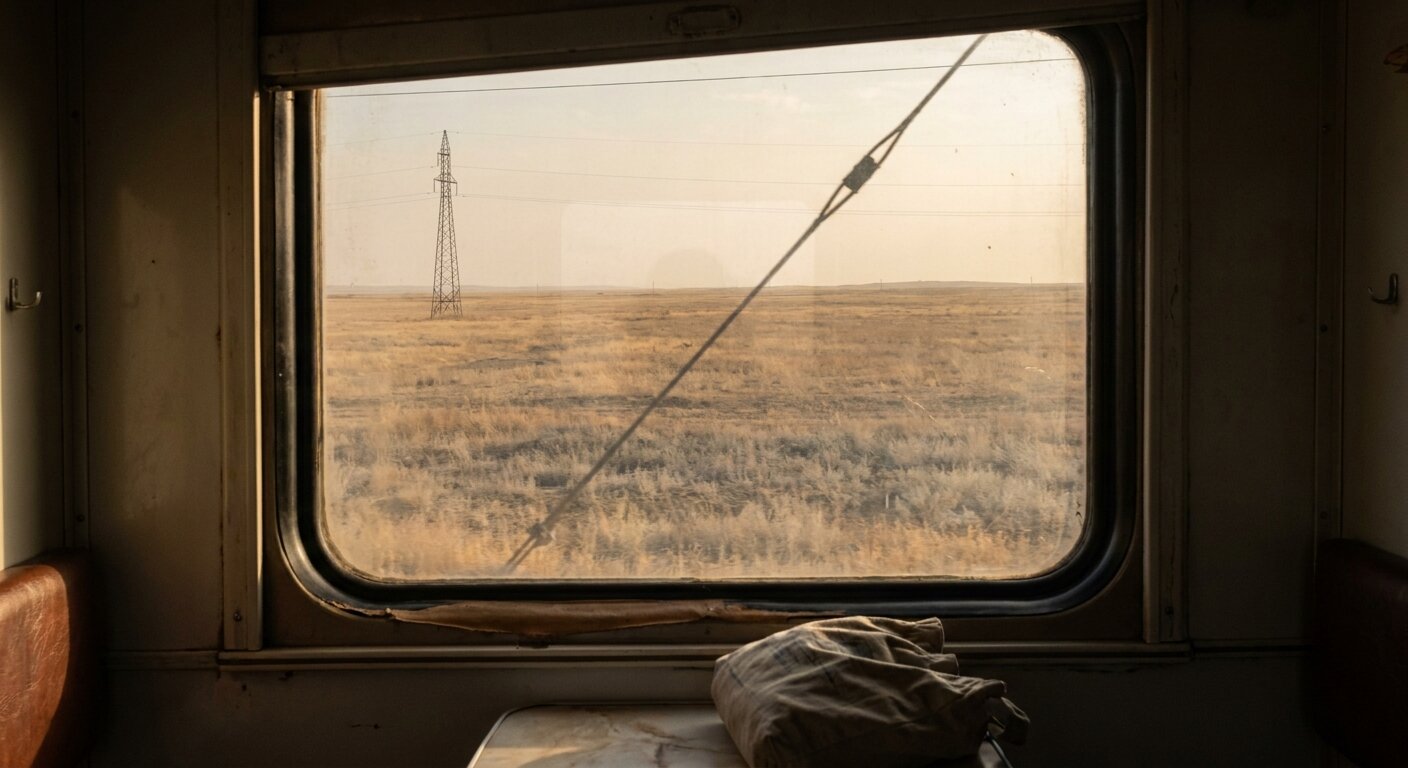
The steppe south of Astana is the same steppe I watched going north four days ago. The light is different in the afternoon — warmer, more horizontal. A power line tower passed the window at 14:37:02. I noted the time out of habit. I did not have the Nokia Method set up.
The coordinates are still in my coat pocket.
Almaty tomorrow, approximately 06:00.
Current status:
- Grigory: found “integrated at the request of a superior authority” in 1972 handover notes — confirms Belov from independent source; “I spent twenty-eight years on that corridor. I did not know what I was working with.”
- Artyom’s drift: explained — Kostanay substation upgrade (late March) changed corridor impedance; signal reflects more strongly; “Someone filed the paperwork.” Beat 2 closed.
- Ogarev: no reply sent, no follow-up received; JETP Letters: no acknowledgement (day 4)
- Coordinates: still in pocket
- Arrival: Almaty, approximately 06:00 April 18
- Emotional state: southbound
Previous post: The Day After