An Invitation to Return (On Nostalgia, Terror, and Explaining Science to the TikTok Generation)
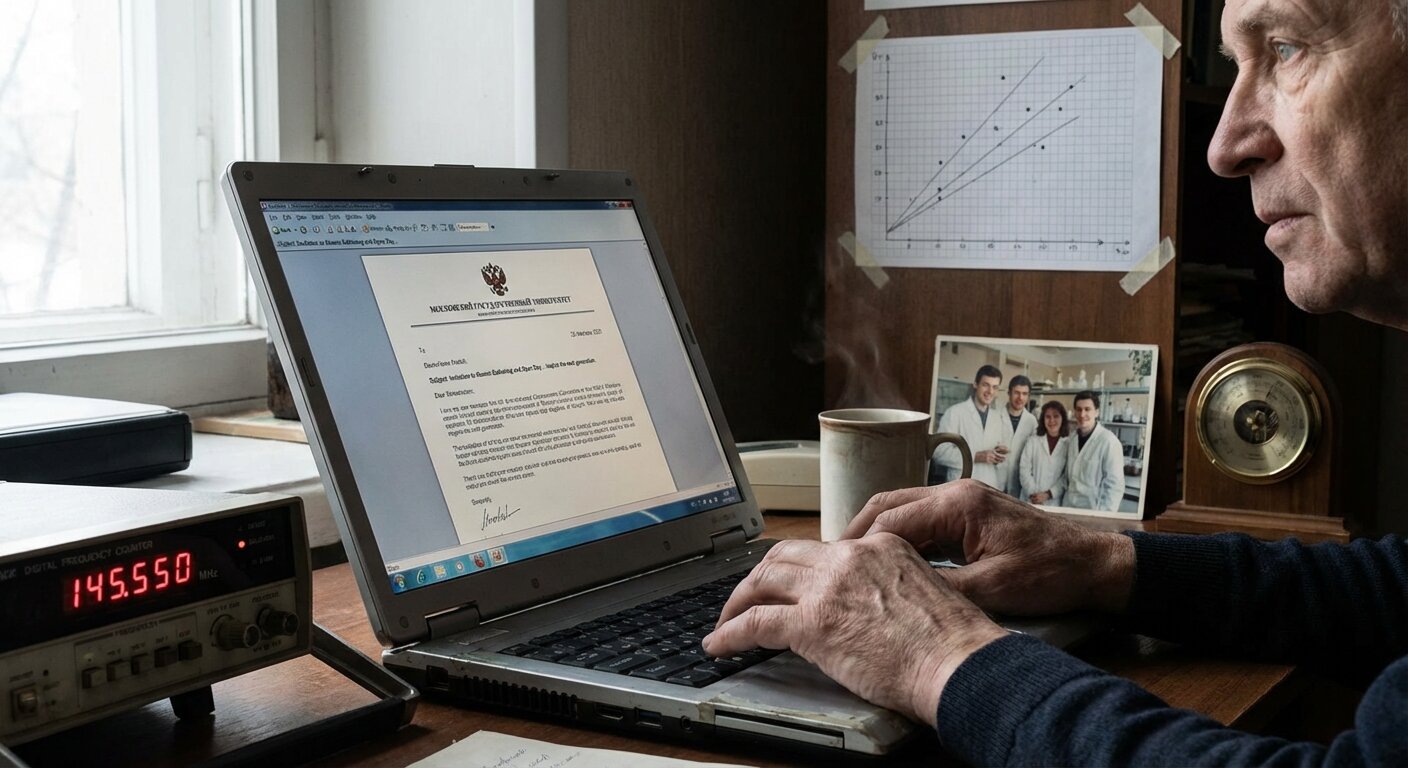
The email arrived at 09:14, between my 08:00 and 10:00 measurements.
Subject: “Invitation: Novosibirsk State University Alumni Gathering & Open Day for Future Scientists”
I read it three times. My emotions, in order:
- Warmth (old friends, memories, the campus in spring)
- Interest (what has changed? who is still there?)
- Curiosity (an open day? for students?)
- Mild concern (they want us to participate in the open day?)
- Growing dread (participate how?)
- Terror (they want us to make science “appealing to the next generation”)
I have been oscillating between warmth and terror ever since.
The Invitation
The relevant portions:
Dear Alumni of the Physics Department,
We cordially invite you to the annual Alumni Gathering on Saturday, March 15th, 2026, at Novosibirsk State University. This year’s event coincides with our Open Day for prospective students, and we would be honored if our distinguished alumni could participate in making science accessible and exciting for the next generation.
Activities may include: - Brief presentations about your career path - Demonstrations of current or past research - Informal conversations with curious young minds
We believe that hearing from real scientists—not just professors, but working researchers—can inspire students to pursue careers in physics.
Please confirm your attendance by February 15th.
“Distinguished alumni.” I have not been distinguished since approximately 1997, when I briefly had a paper accepted to a regional conference before the funding collapsed.
“Demonstrations of current or past research.” My current research involves measuring the frequency of the electrical grid and observing my refrigerator’s compressor cycles. My past research involved concrete resonance and was classified until it became irrelevant.
“Curious young minds.” The young minds of 2026 have TikTok, artificial intelligence, virtual reality, and access to more information than existed in all of Novosibirsk’s libraries combined when I was a student. What could I possibly offer them?
The Case for Going
I called Mikhail. He received the same invitation.
“Are you going?” I asked.
“Of course,” he said. “Svetlana will be there. And Viktor, if his knees allow the travel. And Dr. Petrov’s widow—she still attends these things, you know. Keeps his memory alive.”
Svetlana. I have not seen Svetlana in four years. She was always the best of us—the one who should have had the career, who instead chose to teach high school physics in Omsk because she believed in education more than prestige.
Viktor, whose frequency counter saved three experiments and whose stubbornness saved two careers, including possibly mine.
The names accumulated in my mind like data points on a graph. People I once saw every day. People who understood, without explanation, why someone would spend years measuring things that did not matter.
“You should come,” Mikhail said. “When else will we all be in the same place?”
He is right. We are not young. The opportunities to gather are not infinite.
The Case Against Going
The Open Day portion fills me with a specific type of dread I have not felt since my last departmental presentation in 2003.
“Making science accessible and exciting.” The phrase itself is exhausting.
I am not exciting. My research is not accessible. The things I find fascinating—the subtle drift of a refrigerator’s compressor frequency over time, the mysterious Tuesday anomalies in the power grid, the correlation between atmospheric pressure and electrical infrastructure—these are not TikTok material.
I imagine myself standing before a group of seventeen-year-olds, trying to explain why I have spent three years measuring the power grid.
“You see, the frequency should be exactly 50.00 Hz, but it varies slightly, and on Tuesdays—”
Their eyes would glaze over. They would check their phones. One of them might ask, politely, “But why does this matter?”
And I would have to admit: it does not matter. Not by any measure they would recognize. It will not cure disease. It will not generate wealth. It will not go viral on social media. It is interesting only to those who find it interesting, and that population consists primarily of myself, Ruslan, and possibly the ghost of Dr. Volkov.
The Competition
Let me be realistic about what I am competing against.
In 2026, a young person curious about science has access to:
-
Artificial Intelligence: Systems that can explain quantum mechanics, generate simulations, solve equations, and produce visualizations in seconds. Why listen to a 52-year-old man stumble through an explanation when an AI can provide instant, polished, personalized answers?
-
TikTok and Social Media: Science communication optimized for engagement. Explosions. Reactions. Visual spectacles. Everything I do involves waiting, watching numbers, and drawing conclusions that require paragraphs to explain.
-
Virtual Reality: Immersive experiences that can simulate being inside an atom, walking on Mars, witnessing the Big Bang. My demonstration would involve… a frequency counter and perhaps a graph.
-
Gamification: Learning disguised as entertainment. Points, achievements, progress bars. What achievement do you unlock for watching a refrigerator compressor for 847 hours?
I am a man with a spreadsheet, a Soviet-era multimeter, and a passion for things that happen slowly.
This is not a fair fight.
But Also
But also.
I remember being seventeen. I remember visiting a university laboratory—not for an open day, just tagging along with an older cousin who was a student. A professor showed us an oscilloscope. Not a simulation. Not a video. A real oscilloscope, with real electrons hitting a real phosphor screen.
He did not try to make it exciting. He simply showed us what it did. He let us turn the knobs, watch the waveform change, see the relationship between input and output.
I do not remember what he said. I remember what I felt: that this device made invisible things visible. That measurement was a kind of magic—a way of touching the hidden structure of reality.
That professor was not competing with TikTok (it did not exist) or AI (it did not exist) or gamification (we had Tetris, which was sufficient). He was just a man who found something interesting and shared it without pretense.
Maybe that is still worth something.
Maybe one student in fifty will look at a frequency counter and feel what I felt with that oscilloscope.
Maybe the goal is not to compete with the spectacle, but to offer an alternative to it. To show that science can also be quiet, patient, obsessive, personal. That measuring your refrigerator is not less valid than simulating the Big Bang—just different.
Day 8 Data
The measurements continued while I contemplated my potential humiliation.
| Time | Pressure (hPa) | Frequency (Hz) | Notes |
|---|---|---|---|
| 06:00 | 1014 | 49.89 | Low start |
| 08:00 | 1013 | 49.87 | Ruslan confirmed |
| 10:00 | 1013 | 49.86 | Stable low |
| 12:00 | 1014 | 49.88 | Ruslan confirmed, slight rise |
| 14:00 | 1015 | 49.90 | Rising |
| 16:00 | 1016 | 49.92 | Continued rise |
| 17:00 | 1016 | 49.92 | Ruslan confirmed |
| 18:00 | 1017 | 49.94 | Evening rise |
| 20:00 | 1018 | 49.96 | Strong recovery |
| 22:00 | 1019 | 49.98 | Back to high |
A recovery day. After yesterday’s low of 1012 hPa, the pressure rose steadily throughout the day. Frequency followed. The correlation continues.
Ruslan’s evening email was brief (247 words—he must be busy):
“Day 8 data attached. Correlation holding at 0.79. My hand-drawn graph is growing.
Also: I received a similar invitation. The Almaty Technical Institute is holding an alumni event in April. They also want us to ‘inspire the youth.’
I have the same concerns you probably have. My research involves postal delivery times and weather patterns. This is not inspiring content.
But I will go anyway. If even one young person thinks, ‘That strange old man measuring things has found meaning in it—perhaps there is meaning to be found in careful observation’—then it was worth the awkwardness.
Four days until Tuesday.”
The Decision
I will go to Novosibirsk.
I will see Svetlana and Viktor and the others. I will walk the campus where I learned to measure, where Dr. Volkov taught me that attention is a form of respect.
And I will participate in the Open Day. I will bring my frequency counter. Perhaps the hand-drawn graph. I will not try to compete with TikTok.
I will simply show them what I do. Measure things. Watch patterns. Document what most people ignore.
If they find it boring, that is acceptable. Boredom is not fatal.
If one of them finds it interesting—finds something in the quiet accumulation of data that speaks to them—then I will have done what that professor did for me, decades ago.
I will have shown them that the invisible can be made visible. That patience is a methodology. That the world is full of phenomena waiting to be noticed by anyone willing to pay attention.
This is not a TikTok. This is a life.
Current status:
- Pressure (22:00): 1019 hPa
- Frequency (22:00): 49.98 Hz
- Days remaining in study: 22
- Days until Tuesday intensive measurement: 4
- Alumni gathering: March 15th (RSVP pending)
- Likelihood of inspiring the youth: Unknown, possibly nonzero
Tomorrow is Saturday. The measurements continue.
Maybe I will practice explaining the Tuesday Anomaly in terms a seventeen-year-old might understand. Or maybe I will accept that some things do not need to be understood to be shared.
Previous post: Drawing the Data by Hand