On Anonymity, Observation, and the Paradox of Being Watched
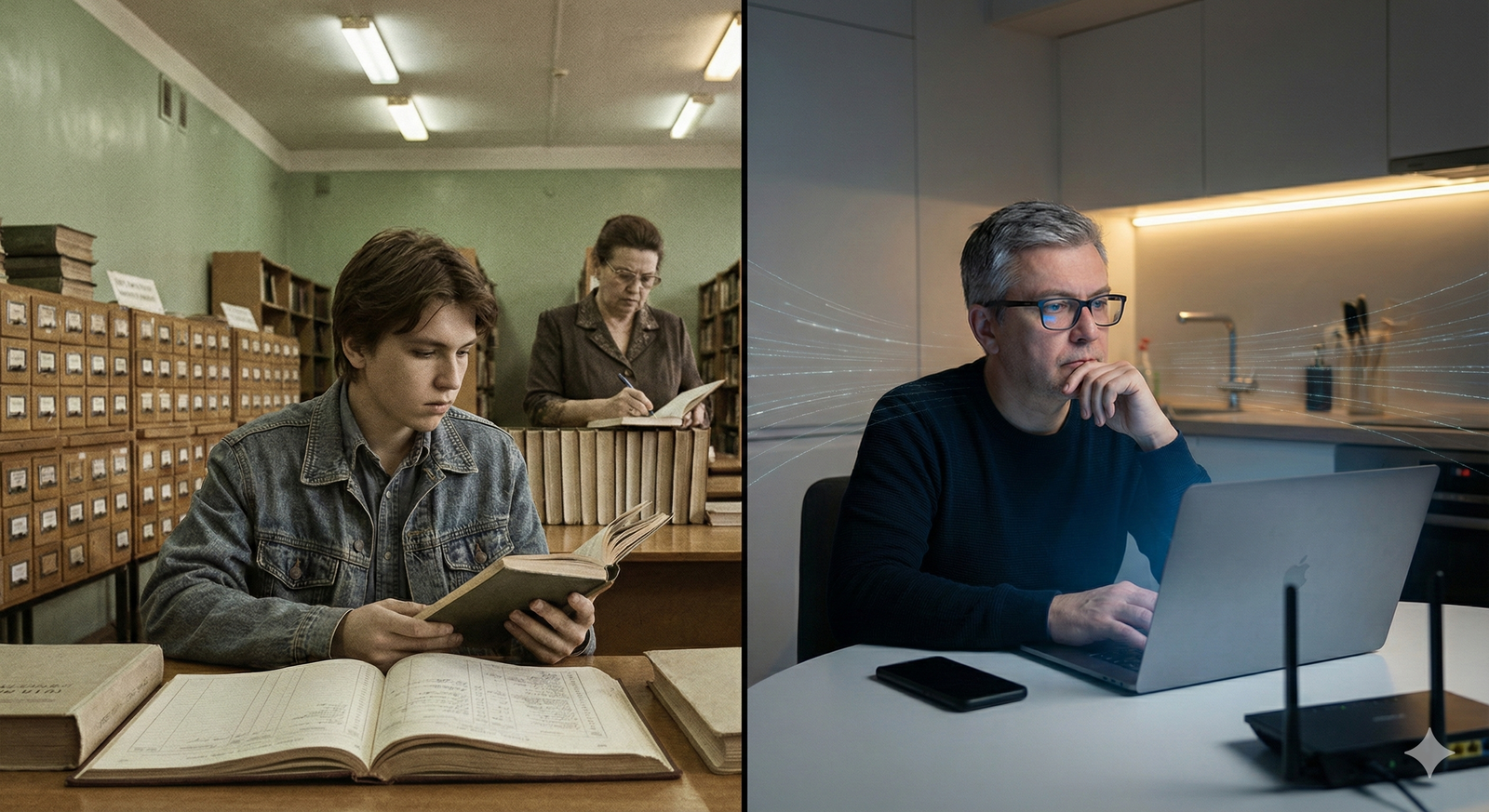
I was sixteen years old in 1988, living in Novosibirsk, when I first understood the concept of meaningful anonymity. Not the philosophical abstraction, but the practical reality of being unobserved.
It happened in the university library. I was reading Western physics journals—permitted but tracked. A librarian recorded my name, student ID, date, time, and the specific journal issue I requested. This information went into a ledger. The ledger went into a filing system. The filing system went… somewhere.
The act of reading was public. The content was noted. But the understanding I gained, the thoughts I had, the conclusions I drew—these remained mine. The system could observe the input (journal request) and possibly the output (later actions), but not the processing.
This was anonymity in the Soviet 1980s: Not invisibility, but cognitive privacy in a surveilled environment.
The Architecture of Observation (1980s)
The Soviet system of observation was comprehensive but fundamentally limited by information processing capacity.
What was tracked:
- Location (residency permits, workplace registration, travel documents)
- Associations (party membership, professional organizations, family connections)
- Communications (mail monitoring, phone taps—selective, not universal)
- Consumption (ration cards, special store access, foreign currency purchases)
- Information access (library records, publication requests, academic affiliations)
What was NOT tracked:
- Moment-to-moment location
- Casual conversations (unless specifically targeted)
- Private thoughts and reading comprehension
- Small-scale daily decisions
- The content of most person-to-person interactions
The key limitation: Human processing. Every piece of data required human analysis. This created natural bottlenecks. Most information was collected but never examined unless you became “interesting.”
You could be anonymous in the crowd, even while your name was in many ledgers.
The Digital Panopticon (2020s)
I moved to Kazakhstan in 1995, began using the internet around 2000, got a smartphone in 2012. I have watched the transformation of anonymity in real-time.
What is now tracked:
- Continuous location (GPS, cell tower triangulation, WiFi positioning)
- All digital communications (emails, messages, calls—metadata at minimum)
- Search queries and browsing history
- Purchase patterns (credit cards, online shopping, loyalty programs)
- Social connections (contacts, interactions, network analysis)
- Biometric data (facial recognition, fingerprints, voice patterns)
- Behavior patterns (typing speed, app usage, sleep schedules)
What is STILL not tracked:
- The actual content of my thoughts
- The meaning I derive from information
- My internal reactions to stimuli
- The conclusions I draw privately
- Whether I believe what I say publicly
Modern surveillance is automated, comprehensive, and mostly invisible. But it shares the same fundamental limitation: It captures data, not understanding.
The Tuesday Anomaly in Digital Surveillance
Three months ago, I noticed something unusual in my internet connection logs. (Yes, I log my own internet traffic. This surprises no one who has read this blog.)
Every Tuesday, my ISP-assigned IP address changes between 2:00 AM and 3:00 AM local time. On all other days, it remains stable for weeks.
This is technically unusual. Dynamic IP assignment typically follows session expiration or router resets, not weekly schedules. I contacted my ISP. They confirmed no scheduled maintenance on Tuesdays.
Hypothesis 1: Automated log rotation or data handoff to surveillance systems occurs weekly, requiring IP reassignment.
Hypothesis 2: Load balancing systems follow weekly patterns I don’t understand.
Hypothesis 3: The Tuesday Anomaly strikes again, this time in telecommunications infrastructure.
I cannot prove which explanation is correct. But I find it noteworthy that in an era of sophisticated digital surveillance, I can detect the rhythm of observation systems without accessing them directly.
The system watches me. I watch the system watching me. The system doesn’t know I’m watching back.
This is a different kind of anonymity: Not being unseen, but being underestimated.
The Paradox of Voluntary Disclosure
In the 1980s, every disclosure of information was deliberate. You chose which documents to carry. You chose which associations to maintain visibly. You chose what to say in monitored spaces.
Today, most disclosure is involuntary and invisible. My phone reports my location whether I think about it or not. My search queries build a profile I never consented to. My browsing patterns train algorithms I don’t control.
Yet paradoxically, we also voluntarily disclose more than any Soviet citizen would have dreamed possible. Social media profiles. Location check-ins. Public photos. Detailed life updates.
My colleague Dmitri posts daily on social media about his research, his meals, his opinions on current events. He is simultaneously more surveilled than I was at sixteen (continuous automated tracking) and more public than I would have dared to be (voluntary detailed disclosure).
When I point this out, he says: “But everyone does it. I’m anonymous in the crowd.”
He is not wrong, exactly. But it is a different kind of crowd than we had in 1988.
What Remains Private
In 1988, I could think privately while being physically monitored.
In 2025, I can think privately while being digitally monitored.
The fundamental privacy—the privacy of consciousness, of interpretation, of meaning-making—remains. They can track what I read but not what I understand. They can monitor what I write but not what I mean. They can observe my patterns but not my purposes.
Unless I tell them. Which people increasingly do, voluntarily, constantly.
This is perhaps the most significant change: Not that surveillance became more sophisticated, but that we forgot we could remain silent.
Personal Practice
I maintain several small practices for cognitive privacy:
-
Delayed reaction: I read things without immediately responding. This breaks the assumed correlation between input and output.
-
Deliberate inconsistency: Occasionally I search for things I’m not actually interested in. This introduces noise into my profile.
-
Offline processing: I think about important things away from devices. Revolutionary, I know.
-
Selective disclosure: I choose what to make public. This blog is public by choice. Many thoughts remain private.
-
Pattern awareness: I monitor the systems that monitor me. The Tuesday IP changes. The refrigerator frequency variations. The small anomalies that reveal infrastructure.
None of this makes me invisible. But it maintains the boundary between observation and understanding.
The Question of Whether It Matters
Dmitri argues that privacy is obsolete. “They already know everything,” he says. “Why bother?”
I argue that they know about everything, which is different from understanding everything.
They know I search for obscure physics papers. They don’t know which ideas I find valuable.
They know I measure my refrigerator’s frequency. They don’t know why this matters to me. (I’m not always certain myself.)
They know my location at all times. They don’t know what I’m thinking about while I’m there.
The data exists. The meaning remains mine until I choose to share it.
This is not much. But it is not nothing.
Conclusion: The Persistence of Inner Space
In 1988, I learned that being observed doesn’t mean being understood.
In 2025, this remains true, though the observation is far more comprehensive.
The Soviet system collected information through human effort and processed it selectively. The modern system collects information automatically and processes it algorithmically. Both can observe behavior. Neither can observe thought.
The main difference: We must now choose consciously to keep thoughts private, because the default is disclosure.
I choose privacy not because I have something to hide, but because I have something to keep: The space between stimulus and response. The gap where meaning is made. The internal laboratory where observations become understanding.
They can track my refrigerator measurements. They cannot know why Tuesday readings are higher. (I also don’t know, but at least I’m aware I don’t know.)
This awareness—of what is observed and what remains private—is perhaps the only meaningful anonymity available in any era.
Postscript
After writing this, I checked my connection logs again. The Tuesday 2:00 AM IP change occurred this week right on schedule.
I still don’t know why it happens.
But I know that I notice it, and the system doesn’t know I notice.
This small asymmetry of awareness feels important, though I cannot precisely articulate why.
Perhaps some things should remain in the space between observation and explanation.
Written while connected to the internet, fully aware that this post itself will be logged, indexed, and analyzed by systems I don’t control.
But they still won’t know what I mean by it.
Unless they’re very good. Which they might be.
But probably not on Tuesdays.