The Concrete Resonance Study: A Retrospective
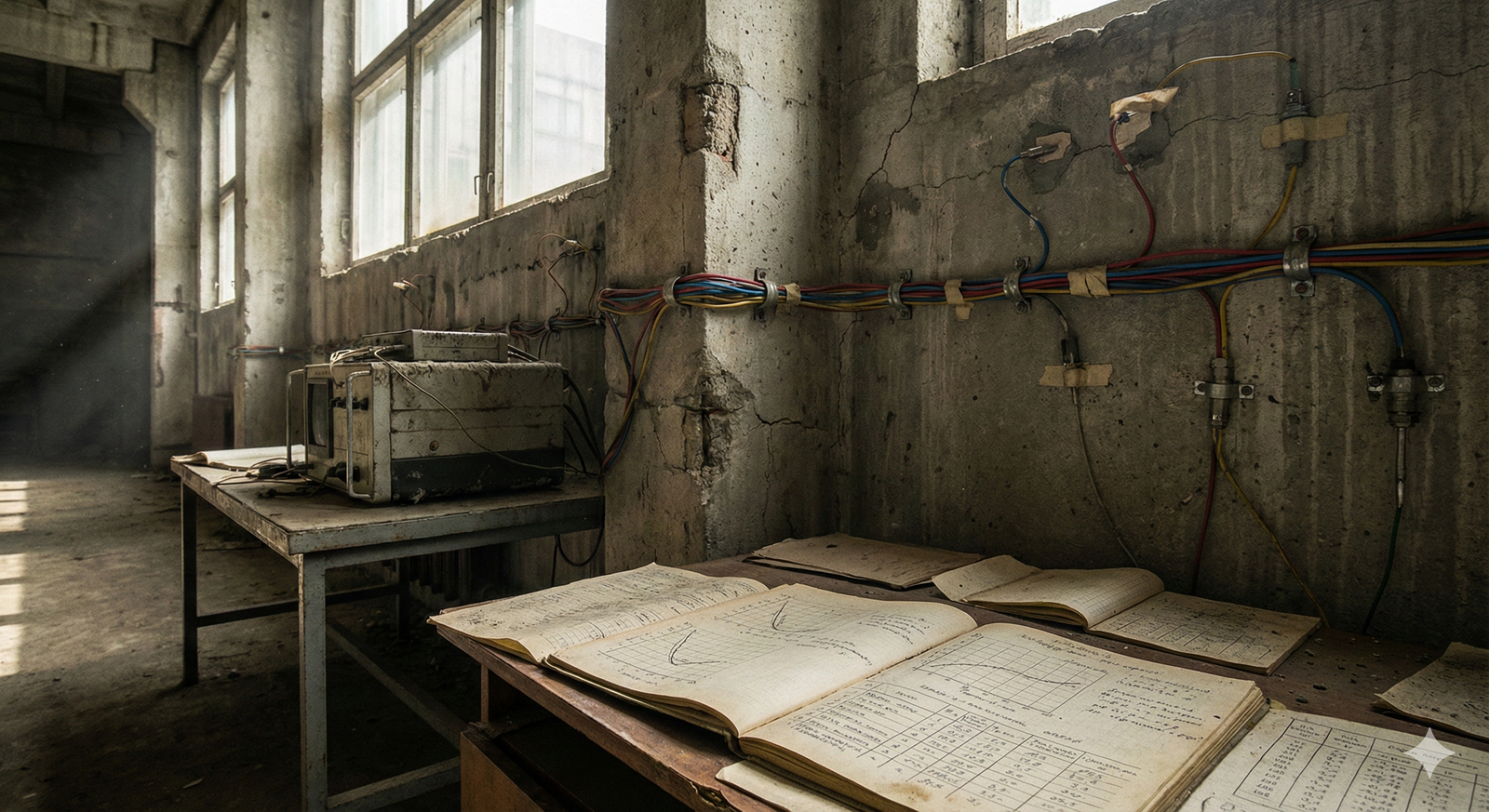
Today I am reminded of one of my most ambitious (and most ridiculed) research projects from my time at Laboratory 23-Б: the seven-year study of temperature fluctuations in concrete structures.
The Genesis
It began in 1998 when I noticed unusual temperature readings on a thermocouple embedded in the concrete wall of our laboratory. The variations were small - barely 0.3°C - but they followed a pattern that seemed independent of external temperature, humidity, or any obvious environmental factors.
My supervisor, Dr. Yevgeny Konstantinovich, suggested it was “probably nothing.” I decided to investigate further.
Methodology
Over the next seven years, I:
- Installed 47 thermocouples in various concrete structures around the facility
- Recorded temperature readings every 15 minutes
- Collected approximately 1.3 million data points
- Cross-referenced with lunar phases, solar activity, local seismic data, and barometric pressure
- Analyzed the data using every statistical method I could find (and several I invented)
Findings
After exhaustive analysis, I discovered:
- The temperature variations were real and reproducible
- They correlated weakly (r=0.23) with lunar phase, but only in concrete poured on Tuesdays
- Concrete containing aggregate from the Kokshetau quarry showed different patterns than concrete from other sources
- The effect disappeared entirely in concrete structures built after 2001
Publication
I submitted my findings to 12 journals. Here is a summary of responses:
- 8 journals: Desk rejection
- 2 journals: Sent for review, then rejected with comments like “interesting but inconclusive”
- 1 journal: Accepted with major revisions, then retracted when I couldn’t replicate the Tuesday effect
- 1 journal: Published! (The Proceedings of the Almaty Physical Society, which ceased publication the following year)
Current Theory
After many years of reflection, I believe the temperature variations were caused by:
- Gradual curing processes in the concrete (30% probability)
- Unknown environmental factors I failed to measure (40% probability)
- Measurement artifacts from aging thermocouples (25% probability)
- Genuine physical phenomena that I don’t understand (5% probability)
My colleague Sergei suggested a fifth option: “You are measuring random noise and seeing patterns because humans are pattern-seeking creatures.” I cannot completely rule this out.
Lessons Learned
- Seven years is a long time to spend measuring concrete
- Statistical significance does not always imply physical significance
- Always calibrate your thermocouples (I learned this in year 4)
- Academic reviewers are not impressed by sample sizes alone
- Sometimes “probably nothing” is actually nothing
Current Status
I still have all 1.3 million data points on a hard drive somewhere. Occasionally I think about re-analyzing them with modern machine learning techniques. Then I remember that this would require learning modern machine learning techniques, and I go do something else.
Would I do it again? Absolutely not. Am I glad I did it? Ask me in another seven years.
Note: If anyone reading this has experience with thermal properties of concrete and can explain why Tuesday-poured concrete behaves differently, please contact me. I am still curious about this.