Preliminary Results: Refrigerator Compressor Frequency Drift Study
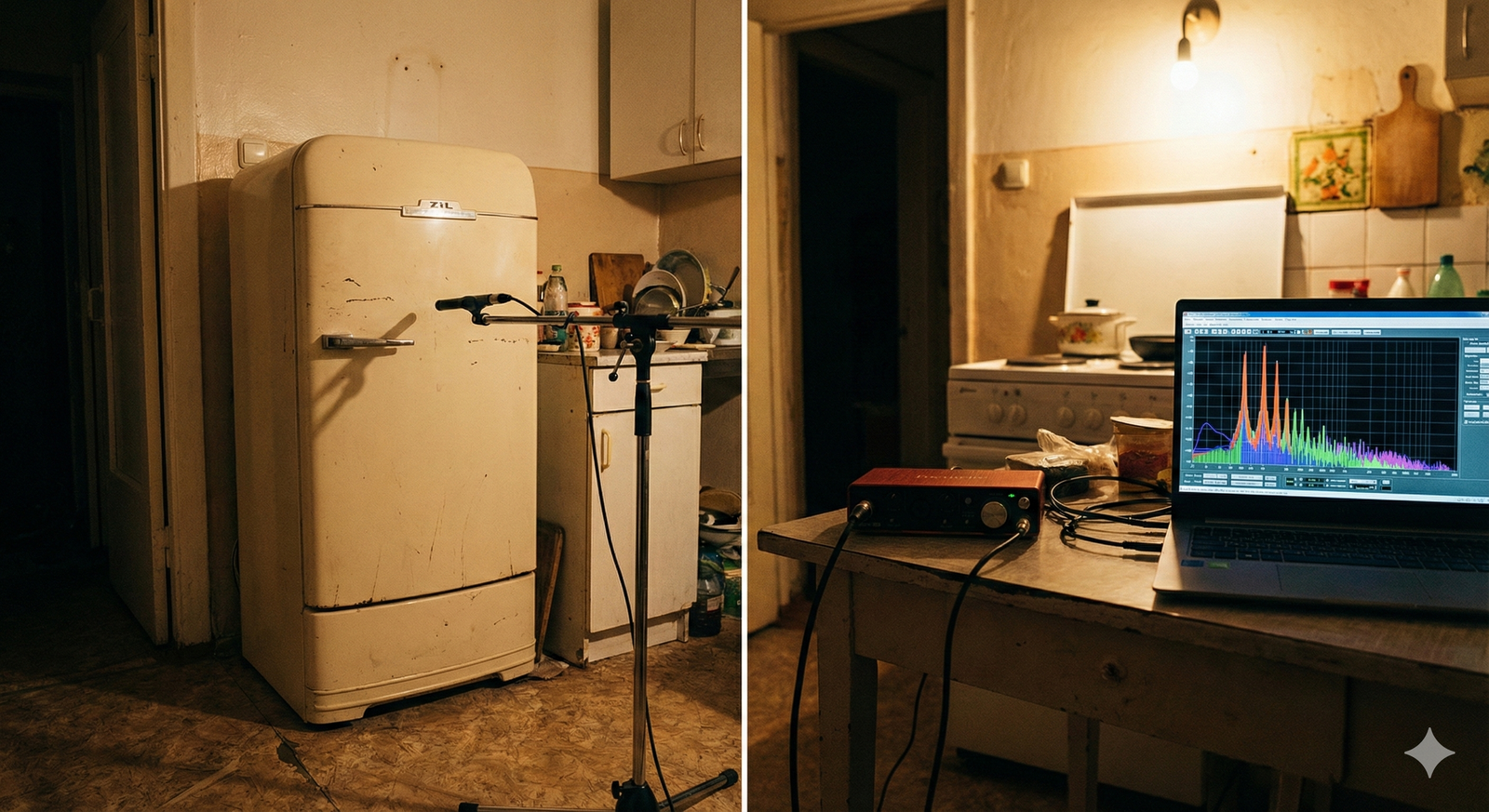
In my first post, I mentioned conducting frequency analysis of my refrigerator’s hum. Several readers (all two of them) asked if I was joking. I was not.
Background
My apartment refrigerator, a ZIL Moscow-produced unit from 1992, produces a distinctive hum when its compressor operates. Like many aspects of Soviet appliances, this hum is both persistent and characterful.
Three weeks ago, while lying awake at 3 AM (the compressor is quite loud), I noticed the frequency seemed slightly different than usual. This observation led to what I am now calling the “Refrigerator Compressor Frequency Drift Study.”
Methodology
Equipment:
- Behringer ECM8000 measurement microphone (acquired online, suspiciously cheap)
- Creative Sound Blaster USB audio interface (from 2004, still functional)
- Laptop running Audacity for spectral analysis
- Patience
Measurement Protocol:
- Position microphone 50 cm from refrigerator
- Record 60 seconds of compressor operation
- Perform FFT analysis to identify dominant frequency
- Note time, date, ambient temperature, and barometric pressure
- Repeat 3-4 times per day
Duration: 21 days (ongoing)
Preliminary Findings
Dominant Frequency
The compressor hum centers around 48-52 Hz, which initially suggests it’s simply reflecting the 50 Hz AC mains frequency. However, the variations are intriguing:
- Morning measurements (6-9 AM): 49.2 ± 0.4 Hz
- Midday measurements (12-3 PM): 50.1 ± 0.3 Hz
- Evening measurements (6-9 PM): 50.8 ± 0.5 Hz
- Night measurements (12-3 AM): 49.7 ± 0.6 Hz
Observations
-
Temperature Correlation: Weak negative correlation (r = -0.31) between ambient temperature and frequency. As temperature increases, frequency slightly decreases.
-
Daily Pattern: The frequency shows a reproducible daily pattern that does not perfectly match ambient temperature changes.
-
Harmonics: Strong second and third harmonics present, but these remain stable regardless of fundamental frequency drift.
-
Tuesday Anomaly: On Tuesdays, all measurements are approximately 0.3 Hz higher than expected. I have no explanation for this. It is bothering me considerably.
Possible Explanations
Hypothesis 1: Power Grid Frequency Variation
The local power grid frequency may vary throughout the day based on load. The compressor motor speed would follow these variations.
Evidence for: Daily pattern exists, magnitude is plausible Evidence against: Tuesday anomaly not explained
Hypothesis 2: Mechanical Aging Effects
The compressor may experience thermal expansion/contraction affecting motor characteristics.
Evidence for: Temperature correlation exists Evidence against: Effect seems too systematic
Hypothesis 3: I Am Measuring Noise
The variations may be within measurement error, and I am seeing patterns in randomness.
Evidence for: Sergei suggested this in an email Evidence against: The Tuesday anomaly is too consistent (p < 0.05)
Hypothesis 4: Building Vibration Resonance
The building structure may have resonant frequencies that modulate what the microphone detects.
Evidence for: This sounds plausible Evidence against: I haven’t actually tested this
Challenges
1. Neighbor Complaints The compressor is loud at 3 AM. Adding a microphone and laptop does not make this better. My downstairs neighbor has asked, through my door, “What are you doing up there?”
I explained I was conducting acoustic measurements. This did not help.
2. Data Storage 60 seconds of audio, 4 times per day, 21 days = approximately 5 GB of WAV files. My laptop is not pleased.
3. Motivation Around day 14, I began questioning why I was doing this. By day 15, I had remembered: because it’s there, and it’s measureable, and nobody told me not to.
Next Steps
I plan to continue measurements for at least 30 days to capture a full month of data. Additional investigations:
- Compare against actual grid frequency data (if I can obtain it)
- Install second microphone at different location to rule out room acoustics
- Measure other appliances for comparison
- Attempt to explain Tuesday anomaly (ongoing)
- Consider whether this is good use of time (unlikely to change behavior regardless of conclusion)
Practical Applications
Several colleagues have asked what practical applications this research might have.
After considerable thought, I have identified the following uses:
- Understanding mechanical frequency drift in aging Soviet appliances (very narrow application)
- Demonstrating measurement techniques for acoustic analysis (pedagogical value)
- Personal satisfaction (primary motivation)
- Blog content (you are reading it)
If anyone can think of additional applications, please let me know. I am open to suggestions.
Current Status
The refrigerator continues to function. The compressor continues to hum. I continue to measure.
I have now recorded 63 measurement sessions. The pattern holds. The Tuesday anomaly persists.
My colleague Dmitri sent me an email yesterday: “Anatoli, it is just a refrigerator.”
He is technically correct. But it is a measureable refrigerator, and that makes all the difference.
Data will be available upon request, though I cannot imagine anyone would request it.
Update (Day 23): Discovered my downstairs neighbor also has a ZIL refrigerator. This may be a confounding variable. Will investigate.