Karaganda
The train arrived at 13:47. Twenty-seven minutes late. Ruslan wrote this down. I wrote it down. The provodnitsa did not care.
First Impressions
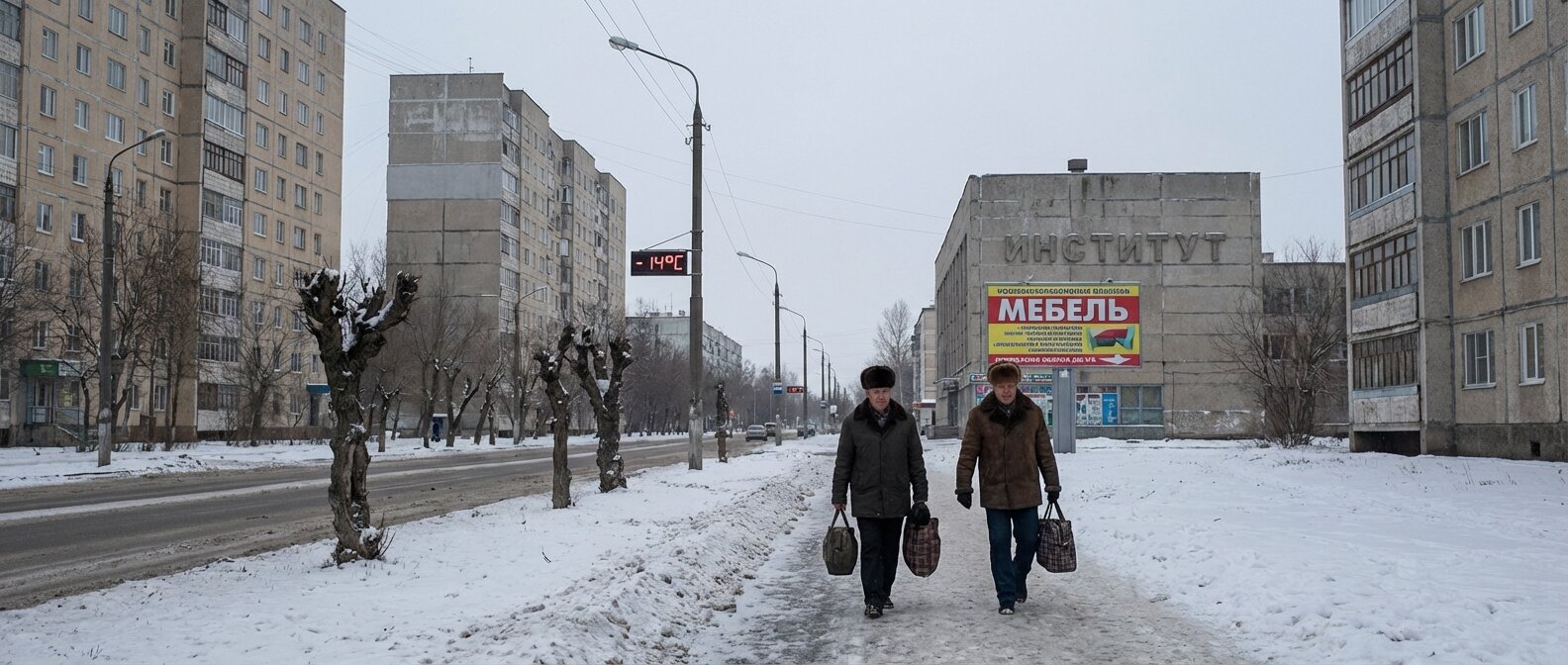
Karaganda in February is exactly what you would expect. Grey sky, grey buildings, grey snow pushed into grey piles along grey streets. The temperature was -14°C when we stepped onto the platform. I know this because Ruslan checked his thermometer before we had left the carriage.
“Cold,” he said.
“It is February in central Kazakhstan.”
“I know. I am making an observation, not a complaint.”
The station is Soviet. Not Soviet-era. Soviet. As if the last sixty years simply did not occur here. The main hall has marble floors with cracks that have been filled and cracked again. The ceiling is high enough to suggest ambition. The heating suggests the ambition was never fully funded.
We collected our bags. Ruslan had slept nine hours. I had slept four, possibly three. The steppe at night is too interesting to waste on sleep, and by morning the steppe at dawn was too interesting to waste on sleep, and now I am running on tea and stubbornness.
The City
We took a taxi to the hotel. The driver asked if we were here for business.
“Research,” Ruslan said.
“What kind?”
“Physics.”
The driver nodded as if this were perfectly normal. Perhaps in Karaganda it is. The city was built on coal mining and Soviet-era industrial research. Half the buildings downtown are former institutes of something.
The hotel is called “Cosmonaut.” I cannot determine if this is aspirational or ironic. The room is clean, warm, and has two beds separated by a nightstand with a lamp that flickers at approximately 3 Hz. I have not measured this. I am estimating. Ruslan would say I should measure it. He is right, but I am tired.
We checked in at 14:30. The meeting with Valentina Sergeevna is at 16:00. Ninety minutes.
Walking
Ruslan suggested we rest. I suggested we walk. Walking won.
Karaganda is a grid. Streets cross at right angles. The buildings are five stories, sometimes nine, always concrete, always the same color - a shade I would describe as “resigned beige.” In summer, I imagine the trees soften this. In February, the trees are black lines against a white sky.
But there is something honest about it. No pretension. No glass towers pretending this is Dubai. Just a city built to house people who dug coal and researched metallurgy, still housing their grandchildren.
We walked past the former Institute of Mining Research. The building is now a furniture store. Next to it, the former Institute of Applied Chemistry is now a supermarket. Ruslan pointed at a third building.
“Institute of Geophysics. Closed 2004.”
“How do you know?”
“I looked it up. Morozov might have worked there.”
I stared at the building. It was an electronics repair shop now. The sign said “FAST FIX” in both Kazakh and Russian. The windows were filled with broken televisions.
Somewhere in this city, thirty-nine years ago, a man measured something that nobody believed. His laboratory is now a repair shop. His data is in his widow’s storage room. His paper has been cited zero times.
Until now.
Preparation
Back at the hotel. 15:20. Forty minutes until the meeting.
I changed my shirt. This seemed important. I do not know why. Valentina Sergeevna will not judge my research based on my clothing. But my mother taught me that you dress properly when visiting a woman of her generation, and some lessons persist regardless of scientific rationality.
Ruslan changed his shirt as well. He did not explain why. We did not discuss it.
I checked the chocolates. They survived the train. This is a relief. Eighteen hours in a heated compartment is not ideal for chocolate, but Kazakh winter compensated through the window.
“What do we say?” Ruslan asked. He was combing his hair. This was the first time I had seen him nervous.
“We say thank you. We look at whatever she wants to show us. We listen.”
“And if the data is useless?”
“Then we still say thank you. And we still listen.”
He nodded. “You are right.”
“I have been thinking about this for a week. I should hope so.”
15:52
We are in the taxi. Eight minutes. Her address is on a street named after a cosmonaut. This seems appropriate for reasons I cannot explain.
Ruslan is holding the chocolates because my hands are not steady.
The taxi driver is playing Kazakh pop music. It is terrible. I am grateful for it because it prevents conversation.
In eight minutes, I will ring the doorbell of a woman I spoke to once on the telephone. She will open the door. Behind her, somewhere in her apartment, are three cardboard boxes containing the work of a man who died before I knew his name.
I do not know what is in those boxes.
In eight minutes, I will begin to find out.
Current status:
- Location: Karaganda, in a taxi
- Temperature: -14°C
- Hotel: Cosmonaut (lamp flickers at ~3 Hz)
- Chocolates: Intact
- Shirt: Clean
- Hands: Unsteady
- Minutes until arrival: 8
- Emotional state: Everything
Previous post: The Train (Hour 1-6)