The Train (Hour 1-6)
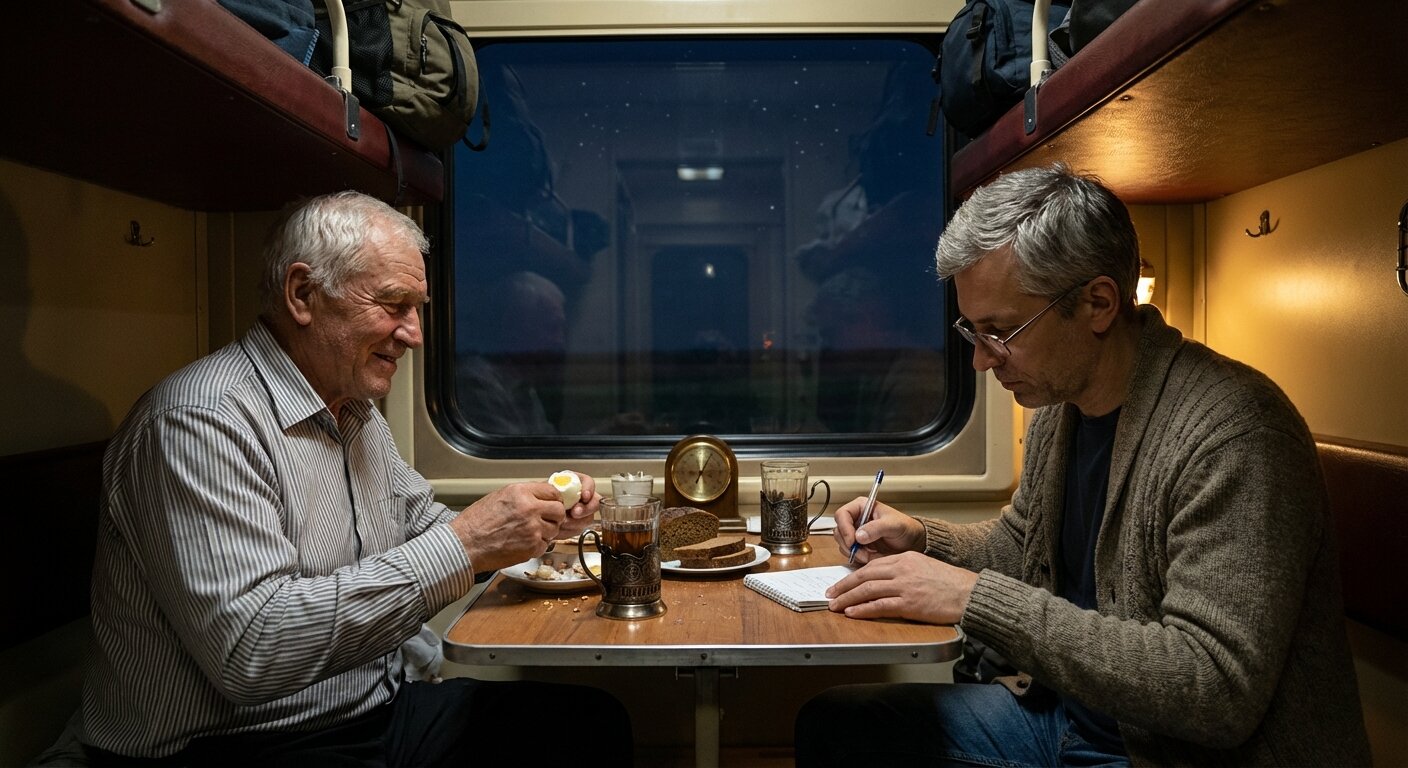
We are on the train.
I am writing this from a kupe compartment, upper bunk, while Ruslan unpacks what appears to be enough food for a geological expedition. The train left Almaty-2 station at 18:47 - two minutes late. Ruslan documented this delay in his notebook. I documented it in mine.
We are already the most thorough passengers on this train.
Hour 1: The Settling
Our compartment is small. Four bunks, two occupied. The other two passengers have not arrived. Perhaps they will board at Shu or Karagaily. Perhaps we will have the compartment to ourselves. I prefer the latter. Ruslan has already claimed enough horizontal surface for a small laboratory.
His luggage:
- One large suitcase (clothing, notebooks)
- One equipment bag (barometer, thermometer, spare batteries)
- One bag of food
My luggage:
- One bag (clothing, notebooks, Ц4353)
- One equipment case (frequency counter, cables, laptop)
- One bag of chocolates for Valentina Sergeevna
Ruslan looked at my single bag of chocolates and then at his food bag. “You travel light,” he said.
“You travel as if supply lines might be cut.”
He began removing items from the food bag. I will document them because I believe this is important for future reference.
| Item | Quantity | Ruslan’s Justification |
|---|---|---|
| Bread (black, round) | 1 loaf | “Essential.” |
| Sausage (smoked) | 400g | “Protein.” |
| Cheese (hard) | 300g | “Also protein.” |
| Boiled eggs | 6 | “Train tradition.” |
| Cucumbers | 4 | “Freshness.” |
| Tomatoes | 3 | “Balance.” |
| Tea (loose leaf, in jar) | 200g | “I do not trust train tea.” |
| Cookies (homemade) | ~20 | “My sister made them.” |
| Apples | 3 | “Vitamins.” |
| Dried apricots | 1 bag | “Energy.” |
| Sugar cubes | 12 | “For tea.” |
| Salt | small container | “For eggs.” |
“This is food for six people,” I said.
“This is food for eighteen hours,” he corrected.
He has a point. The restaurant car on Kazakh trains is unpredictable. Sometimes excellent. Sometimes closed. Sometimes technically open but offering only instant noodles and tepid coffee.
Hour 2: First Measurements
We set up the barometer on the fold-down table. It fits, barely, between the tea glasses and Ruslan’s bread.
The train travels northwest from Almaty, climbing gradually through the foothills before descending into the steppe. This means pressure changes. We agreed to log readings every thirty minutes.
| Time | Location (approx.) | Altitude (est.) | Pressure (hPa) | Notes |
|---|---|---|---|---|
| 19:00 | Almaty suburbs | 850m | 1005.2 | Departure readings |
| 19:30 | Near Kapchagai | 780m | 1007.8 | Slight increase |
| 20:00 | Past Kapchagai | 620m | 1011.4 | Descending toward reservoir |
| 20:30 | Approaching steppe | 540m | 1014.1 | Flattening terrain |
“The gradient is steeper than I expected,” Ruslan said, tapping the barometer.
“We are losing altitude. The Ili basin.”
“I know why. I am saying the numbers are beautiful.”
I looked at the data. He was right. There is something satisfying about watching a physical quantity change smoothly as the landscape changes outside the window. The numbers tell the story of the terrain.
Hour 3: The Provodnitsa
The provodnitsa - the carriage attendant - came by with tea. She is a woman of approximately 45, with the expression of someone who has seen every possible type of train passenger and is no longer surprised by any of them.
She looked at our barometer, our notebooks, and our frequency counter.
“Scientists?” she asked.
“Researchers,” Ruslan said. This is technically more accurate and sounds less impressive, which is honest.
“We had scientists last month. They were studying bird migration from the window. Counted birds for fourteen hours.”
“Did they find anything?” I asked.
“They found a lot of birds.” She placed two glasses of tea on the table. “Do not block the corridor with equipment. And the socket is for phones, not… whatever that is.” She pointed at the frequency counter.
“It draws less power than a phone charger,” I said.
“That is not the point.”
We unplugged the frequency counter. Some battles are not worth fighting.
Hour 4: The Conversation
With the equipment temporarily limited, we talked.
“What do you expect to find?” Ruslan asked. He was peeling an egg. The smell filled the compartment. This is the authentic Kazakh train experience.
“I do not know.”
“You must have a hypothesis.”
“Hypotheses require some basis. I have no basis. I have a dead man’s rejected paper and a widow’s boxes.”
“That is more than you had in January.”
This is true. In January, I had thirty years of personal data, no collaborator, and a growing suspicion that I was measuring noise. Now I have Ruslan. I have Morozov’s paper. I have a confirmed anomaly observed independently at two locations.
And tomorrow I might have original data from 1987.
“I hope his measurement protocol was rigorous,” I said.
“He published in a peer-reviewed journal. Even a minor Soviet one had standards.”
“The paper was rejected for further funding. The reviewers said insufficient evidence.”
“Reviewers.” Ruslan said this the way some people say a profanity. He has opinions about peer review. Most of them unfavorable. Most of them earned.
Hour 5: The Steppe
It is dark outside now. The steppe in February at night is nothing. Not darkness, exactly - there are stars, and occasionally the faint glow of a distant settlement. But mostly nothing. Flat, endless, indifferent.
I pressed my face against the cold window. The glass was vibrating with the rhythm of the rails. Somewhere out there, between here and Karaganda, the power grid hums at 50 Hertz. Or nearly 50 Hertz. With deviations that nobody notices. Nobody except Morozov, who noticed in 1987. And Volkov, who noticed later. And me.
And now Ruslan, who is eating his third egg and reading a paper about ionospheric disturbances.
“Anatoli.”
“Yes?”
“We are doing something real. You know that, right?”
I did not answer immediately. The train rocked gently.
“I am beginning to believe that,” I said.
Hour 6: Sleep Protocol
Ruslan has fallen asleep. He sleeps the way he does everything - thoroughly and without hesitation. Within four minutes of lying down, he was unconscious.
I cannot sleep. The train moves through the steppe at approximately 80 km/h. The barometer reads 1017.3 hPa. The pressure has stabilized as the terrain flattened.
In twelve hours, we arrive in Karaganda. In perhaps sixteen hours, I will meet Valentina Sergeevna Morozova. I will sit in her living room and she will show me boxes that have been waiting for thirty-nine years.
I should sleep. Ruslan would tell me that sleep deprivation degrades measurement accuracy. He would be correct.
But for now I am watching the steppe pass in the dark and listening to the rhythm of the rails and thinking about a man named Viktor Morozov who measured something nobody believed, and a woman named Valentina who kept his papers anyway.
The train rocks. The barometer holds steady. Ruslan snores softly.
I will try to sleep now.
Current status:
- Location: Somewhere between Shu and Zhezkazgan corridor
- Speed: ~80 km/h
- Atmospheric pressure: 1017.3 hPa (stable)
- Eggs consumed (Ruslan): 3
- Eggs consumed (Anatoli): 1
- Provodnitsa approval rating: Low
- Hours until Karaganda: ~12
- Emotional state: Awake
Previous post: The Neighbor’s Request