The Protocol
It is Sunday. The measurement is in two days.
I spent this morning writing a protocol.
What a Protocol Is
A protocol is, in its simplest form, a document that tells multiple people what to do at the same time so that their results mean the same thing. Every laboratory has them. Laboratory 23-Б had them. Ours were usually three pages long, laminated, and attached to the wall with a screw because someone had taken the previous one to write a shopping list on the back.
I have not written a protocol in eleven years.
This one took four hours.
The difficulty is not the physics. The physics is simple: measure the grid frequency continuously from 14:00 to 15:00 local time on Tuesday, February 24. Record a value every thirty seconds. If you see a deviation greater than -0.10 Hz, note the exact time.
The difficulty is that I have three observers and I need them to do identical things in three different ways, because they have three different setups.
| Observer | Location | Timezone | Method |
|---|---|---|---|
| Ruslan Karimovich | ~340 km from Almaty | UTC+5 | Multimeter + logging sheet |
| Anatoli Goverki | Almaty | UTC+5 | Nokia Method (sound card + Python) |
| Mikhail | Novosibirsk | UTC+7 | Frequency counter VC-3165 |
Three observers. Three setups. Two timezones. One Tuesday.
If the anomaly appears at 14:37 local time in both UTC+5 and UTC+7, that means it triggers at different UTC moments — which means the cause is local, not global. If it appears at the same UTC moment (09:37) in both zones, the cause is in the grid itself, at a network level.
This is not a complicated experiment. It is, however, one that required thirty years of preparation.
The Responses
I sent the protocol at 11:14.
Ruslan replied at 11:31. His email was 4,200 words. I know this because I counted. He had seven comments on the protocol, four of which were substantive improvements, two of which were questions I had already answered in section 3 (I did not tell him this), and one of which was a three-paragraph observation about the relationship between measurement standardization and epistemic trust that I genuinely did not expect from a retired postal worker and that I will be thinking about for some time.
He also suggested we synchronize our clocks against an NTP server before the measurement window begins. This was correct. I added it to the protocol.
Mikhail replied at 13:07. His email was eleven words: “Understood. Will measure. My clock is already synchronized. Good luck.”
I have known Mikhail for thirty-one years. This is consistent.
Dima’s message arrived at 15:22. It was not a reply to the protocol — I had not sent it to him, since he is our technical advisor rather than an observer — but it arrived anyway. He had apparently found the protocol on his grandfather’s email (Dr. Yevgeny is copied on everything; I do not know why I started doing this, but I cannot stop now) and had two corrections to the Python script’s timestamp format. He was right about both. He signed off with: “Also the window duration is still a parameter. You can set it to 3600 for the full hour. You are welcome.”
I updated the script.
The Kitchen Table
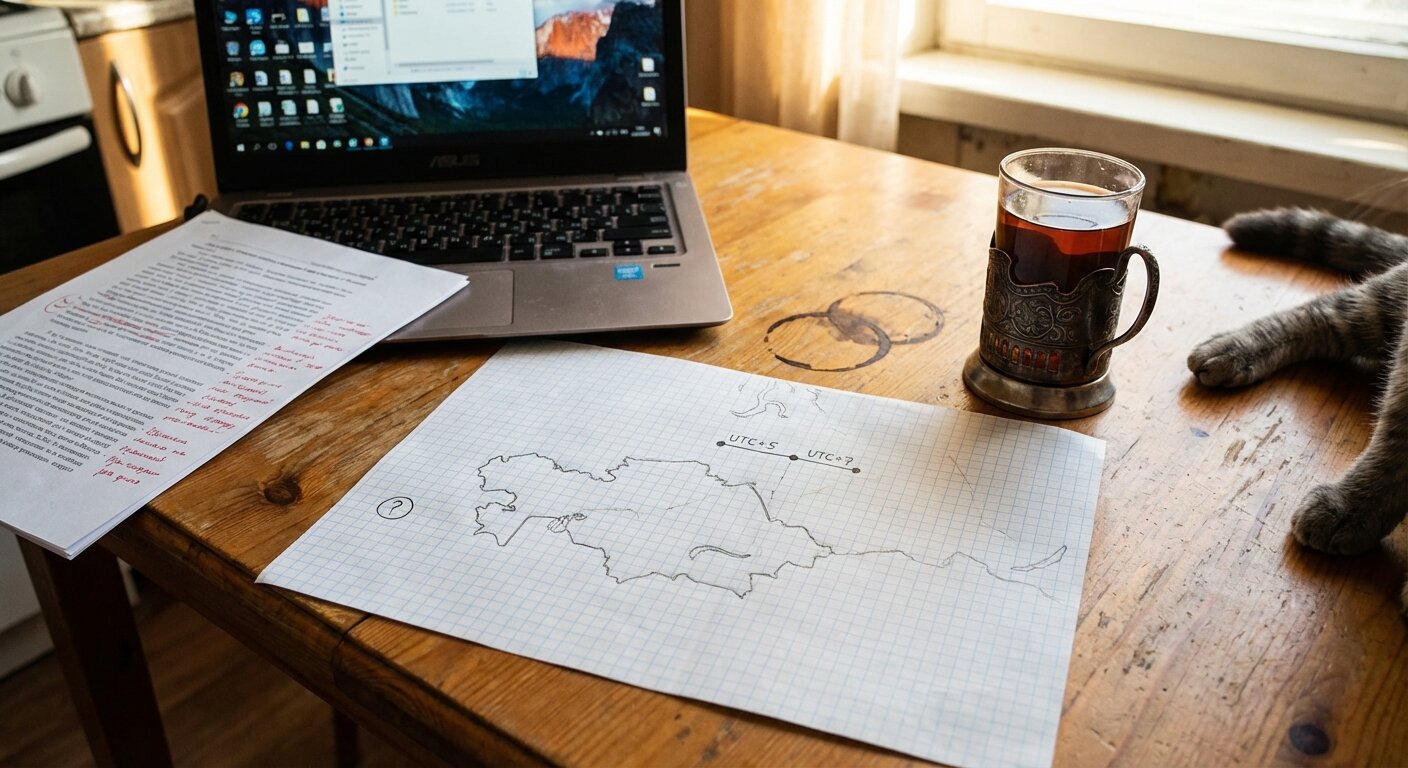
Misha arrived at some point during all of this. I did not note the time, which is unusual for me. I looked up and she was simply there, sitting between the timezone map I had drawn on a piece of graph paper and the laptop with three email tabs open.
She examined the map with the focused attention she usually reserves for the space under the radiator.
I looked at the kitchen table: the map with lines I had drawn in pencil connecting Almaty, Novosibirsk, and a rough circle where Moscow would eventually go. Three coffee rings from three cups of tea. A printout of the protocol with Ruslan’s corrections in red pen (I had printed it, read Ruslan’s email, annotated the printout, then realized I needed to update the digital version). The laptop.
I have coordinated one research project before. This was in 1999, at Laboratory 23-Б. It lasted six weeks and involved two people, both of whom were in the same room. The coordination mostly consisted of me saying “can you hold this” and Dr. Svetlana saying “I am already holding something.”
This is different.
Ruslan is 340 kilometers away and will sit with a clipboard at 14:00 on Tuesday. Mikhail is 2,400 kilometers away and has synchronized his clock and is, apparently, ready. Dima is fourteen years old and is correcting my timestamp formatting from a city I have never visited.
I am the one who sent the protocol. I am, technically, the coordinator.
I do not know when this happened.
On Being Ready
The frequency counter is somewhere between China and Novosibirsk, still in transit. Mikhail has the one I sent him. I have the Nokia charger and the Python script.
We have tested the Nokia Method extensively this week. On Thursday I ran it for four hours continuously. On Friday I ran it while making tea, to test whether kettle vibration introduced noise (it does not, above a threshold of approximately 1.2 meters). On Saturday I ran it while Misha was in the room, to test whether a cat introduces noise (she does not, unless she sits on the laptop, which she did once, briefly, causing a recording artifact I have labeled “Misha Event” in my notes and will not include in the final dataset).
The method is reliable. The accuracy is ±0.003 Hz. The anomaly has measured -0.15 to -0.21 Hz in every confirmed observation. We will see it.
I believe we will see it.
What I do not know is what Mikhail will see at 14:37 his time — which is 12:37 Almaty time — two hours before our measurement window even opens. If the anomaly is local, his 14:37 will show it and ours will show it separately, two hours apart. If the anomaly is global, his 14:37 will show nothing, and ours will show it, and the timestamps will align at 09:37 UTC.
Forty-three years of data. Four independent observers. Two timezones.
Tuesday.
Current status:
- Protocol: final version distributed, v1.2 (incorporating Ruslan’s NTP suggestion and Dima’s timestamp corrections)
- Observers confirmed: Ruslan (UTC+5), Anatoli (UTC+5), Mikhail (UTC+7)
- Nokia Method: tested and stable, ±0.003 Hz
- Replacement frequency counter: still in transit from China
- Misha: present, reviewing map, opinion unknown
- Emotional state: something adjacent to readiness
Previous post: Conversation