The Measurement
I set my alarm for 06:00. I was awake at 05:47.
Before
I started the VC-3165 logging at 07:00. I started the Nokia Method at 07:03. I took a manual reading with The Veteran at 07:05: 50.002 Hz. I wrote it in the notebook. I made tea.
Mikhail’s measurement window was 14:00 to 15:00 Novosibirsk time. In Almaty, that is 12:00 to 13:00. His 14:37 is my 12:37. I had approximately six hours to wait before knowing whether he would see anything.
I spent them digitizing Morozov’s notebooks. I was on page 741. I did not retain much of what I photographed.
At 11:52, I sent Mikhail a message: “Your window opens in eight minutes. Good luck.”
He replied four minutes later: “I know.”
This was the correct reply.
Novosibirsk, 14:37
At 12:41 Almaty time — which is 14:41 Novosibirsk, four minutes after the expected window — my phone showed a message from Mikhail.
The message was nine words:
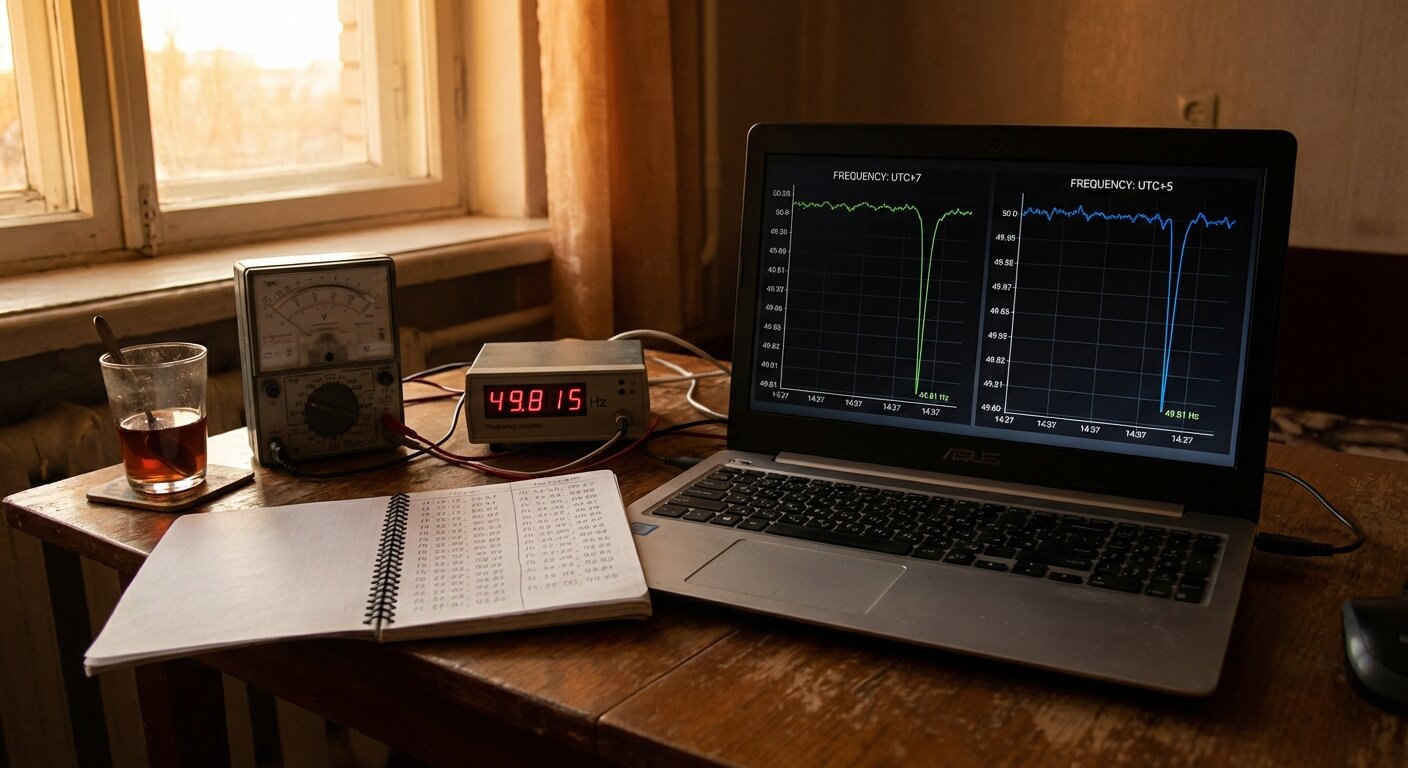
“14:37:19. Minus 0.19. It is there. Two hours.”
I read it three times. The meaning was clear on the first reading, but I read it again anyway.
14:37:19. His local time. His timezone. UTC+7.
In UTC, that is 07:37:19.
In Almaty time, that is 12:37:19 — the moment I was sitting at my desk reading Morozov’s notebook page 743, unaware that 2,400 kilometers away, a retired engineer was watching a number drop by 0.19 Hz and reaching for his phone.
Two hours. He knew. His measurement window had shown the anomaly at his 14:37. Mine would open at my 14:37 — two hours later in UTC. If the anomaly appeared again, it would be at 09:37 UTC. His had been at 07:37 UTC. Two different UTC moments. The same local time.
I sat with this for a moment.
Then I wrote back: “Confirmed. Two hours.”
He sent a thumbs up. Mikhail has used a thumbs up emoji exactly twice in thirty-one years of knowing him. The first time was in 2019, when I told him I had found an apartment in Almaty with southern exposure.
The Two Hours
I called Ruslan at 12:50.
He had seen Mikhail’s message. He had also sent Mikhail a message asking for the raw data file, which Mikhail had already attached. The file was a text document with columns of timestamps and frequency values. Ruslan had opened it.
“The shape is the same,” Ruslan said. “Same dip. Same recovery. He measured it with a different instrument in a different city at a different time and it looks the same.”
I agreed that it looked the same.
“Are you nervous?” he asked.
I told him I was not nervous. I was, in fact, what I can only describe as extremely calm in a way that is probably not actually calm. He said this was the same thing as nervous. I did not argue.
We agreed to compare notes after the measurement. He had his logging sheet ready. His clock was synchronized.
I made more tea. I took a manual reading at 13:00: 49.998 Hz. At 13:30: 50.001 Hz. At 14:00, I opened the measurement window officially, though both automated systems had been running since morning.
I wrote in the notebook: 14:00:00. Systems active. Three instruments. Waiting.
The Ambassador stood on its shelf. Its needle was at 1013 hPa, which is normal for Almaty in late February. Misha was not present. I do not know if this is relevant.
14:37
At 14:36:50, the VC-3165 reading was 49.997 Hz. Within normal variation.
At 14:37:12, it dropped to 49.891 Hz.
At 14:37:19, it reached the minimum: 49.806 Hz.
The deviation from nominal: -0.194 Hz.
The Nokia Method, running simultaneously:
| Time | VC-3165 | Nokia Method | Veteran (manual) |
|---|---|---|---|
| 14:36:50 | 49.997 | 49.998 | — |
| 14:37:00 | 49.994 | 49.993 | — |
| 14:37:12 | 49.891 | 49.889 | — |
| 14:37:19 | 49.806 | 49.808 | 49.81 |
| 14:37:31 | 49.923 | 49.922 | — |
| 14:37:45 | 49.971 | 49.970 | — |
| 14:38:00 | 49.998 | 49.997 | — |
The Veteran reading was at 14:37:19. I was holding the multimeter and watching the needle when it happened. The needle moved. I wrote down what it showed.
I called Ruslan at 14:38:02.
“I saw it,” he said, before I spoke.
His peak was at 14:37:22 with a deviation of -0.187 Hz. Three seconds after mine. Consistent with previous Tuesdays.
What This Means
Mikhail’s peak: 14:37:19 Novosibirsk time. UTC equivalent: 07:37:19. Our peak: 14:37:19 Almaty time. UTC equivalent: 09:37:19.
The difference in UTC: exactly two hours.
The local time in both places: 14:37.
If the anomaly were caused by something at the network level — a load event, a generator synchronization, a transmission phenomenon at a fixed UTC moment — it would appear at the same UTC time in both locations. It did not. It appeared at the same local time.
The Tuesday Anomaly is not a global event. It is not a single UTC-fixed moment propagating through the grid. Whatever causes it, it causes it locally, separately, at 14:37 in each timezone it inhabits.
This does not tell us what it is. It tells us what it is not. These are different things, but both are useful.
Ruslan sent me his spreadsheet at 15:14. It now has nineteen tabs.
Mikhail sent his raw data file at 15:31. He also sent one additional message: “Same as yours. Do you know why yet?”
I replied: “No. But now we know it is not the same event in both places. It is two separate events at the same local time. This is a different problem.”
He replied: “More interesting.”
Mikhail has always had very good scientific instincts. I had forgotten this.
After
I wrote to Valentina tonight.
I told her that we had run the first multi-timezone measurement. I told her the result: local, not global. I told her that Viktor’s data, and all of our data since, is consistent with a phenomenon that occurs at the same local time across different points in the grid — which means the cause is not a single transmission event but something that either repeats independently at each location, or is coordinated by something other than a shared UTC clock.
I told her: the 2,847 measurements Viktor made are not noise. We now have confirmation that what he was measuring was real enough to replicate across 43 years and two timezones.
I do not know if she will understand all of this. I think she will understand the important part.
I also told her that Mikhail said it was “more interesting.” She will not know who Mikhail is. I included this detail anyway.
The measurement window is closed. Tuesday is ending. My notebook has 23 pages of entries from today.
Tomorrow I will start the analysis properly. Tonight I am going to sit here for a while.
Current status:
- Tuesday Anomaly, Week 6: observed at -0.194 Hz (Almaty, 14:37:19 local / 09:37:19 UTC)
- Mikhail (Novosibirsk): -0.19 Hz at 14:37:19 local / 07:37:19 UTC
- Ruslan: -0.187 Hz at 14:37:22 local / 09:37:22 UTC
- Three independent instruments at Almaty confirmed within 0.002 Hz
- Conclusion: anomaly is local, not global. Same local time, different UTC moments.
- Mikhail: “More interesting.”
- Emotional state: I do not have a word for this. Something between confirmed and beginning.
Previous post: The Parcel