Moscow
Tuesday.
-0.192 Hz, at 14:37:21.
The Measurement
Session 33. The results:
| Observer | Location | UTC offset | Local time | Deviation |
|---|---|---|---|---|
| Anatoli | Almaty | UTC+5 | 14:37:21 | -0.192 Hz |
| Mikhail | Novosibirsk | UTC+7 | 14:37:20 | -0.188 Hz |
| Ruslan | ~340 km from Almaty | UTC+5 | 14:37:23 | -0.196 Hz |
Within normal range. Consistent with previous observations. The anomaly appeared, as expected, at approximately 14:37 local time, with no synchronization between observers other than the grid itself.
Mikhail sent his data at 14:52, with no comment attached. This is, I have come to understand, Mikhail’s equivalent of a thumbs-up.
Ruslan’s message arrived at 15:07: three numbers, a note that his new ink cartridge had arrived, and a question about whether I had decided about the pressure measurements on the train. I have not replied to the last part yet.
The Missing Column
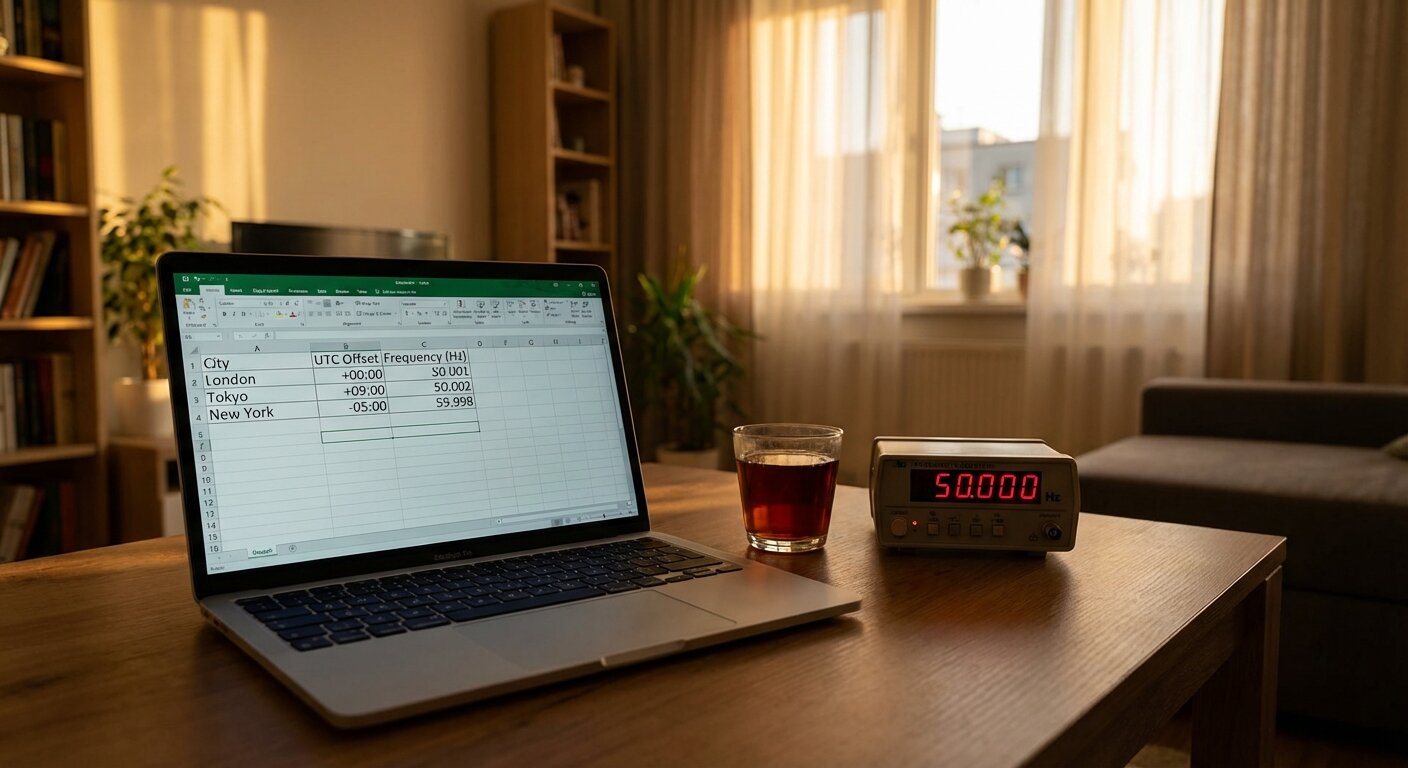
The table above has three rows.
I have been looking at variations of this table since February 24. What I keep noticing is the absence of a fourth row. Specifically:
| Artyom | Moscow | UTC+3 | 14:37 local | ? |
Moscow is UTC+3. If the anomaly is present in the Moscow grid segment, and if it is genuinely local — propagating at local time across the unified system — then it would appear in Moscow at 14:37 Moscow time. This is 11:37 UTC. This is two hours after Almaty, four hours after Novosibirsk.
We have Novosibirsk and Almaty confirmed. If Moscow shows the same pattern at 14:37 local, the sequence would span UTC+3 through UTC+7 — four hours of the unified grid behaving the same way at the same local time. That is not a coincidence. That is a property of the system.
I have been thinking about this since February 25.
Dima
I sent Dima a message this afternoon at 15:23.
I asked whether his friend in Moscow — Artyom, the one he mentioned in February — would be willing to attempt a Tuesday measurement. I explained what would be needed: a laptop, the Nokia Method setup (Dima can send him the instructions), an hour free on a Tuesday afternoon. I said I understood if he was busy or uninterested.
Dima replied in eleven minutes.
His message: “already asked him lol. he said if you send him the protocol he’ll try it. he has a soundcard. he wants to know what Hz you’re looking for.”
I read this message three times.
Dima asked him before I did. I am not sure when. I did not ask.
Artyom
I know the following about Artyom:
- He is in Moscow
- He has a laptop with a soundcard
- He responded to Dima’s message quickly enough that Dima replied to me in eleven minutes
- He wants to know what Hz we are looking for
That last point is, I think, a good sign. Someone who wants to know the target value before they start measuring is either a physicist, or someone trained to be precise, or someone who intends to do this seriously. These are not mutually exclusive.
I wrote back to Dima with the protocol. Full Nokia Method setup instructions, the frequency range to monitor (49.6–50.4 Hz), the target timestamp (14:37 local time, any Tuesday), the expected deviation range (-0.15 to -0.31 Hz based on our 33-session dataset), and a note that a first measurement with no result is also useful data.
Dima replied: “ok sent. he says hi btw”
I do not know Artyom. He does not know me. He said hi anyway.
This is apparently how the network grows: a 14-year-old asks his friend on a Tuesday afternoon, and the friend says yes before being properly asked.
The Table, Revised
If Artyom measures next Tuesday, March 10, the table will have four rows.
Novosibirsk (UTC+7) at 07:37 UTC. Almaty (UTC+5) at 09:37 UTC. Moscow (UTC+3) at 11:37 UTC. Four hours of the same system, measured at the same local moment.
Viktor’s hypothesis requires that the standing wave resonance propagates through the transmission infrastructure. If the timing is genuinely local — if Moscow shows 14:37 and not some other time — then the wave is not being driven externally. It is a property of the network itself, at that length scale.
Sokolov has the documentation for the 750 kV Kazakhstan-Siberia corridor. The archive is on March 14. Eleven days.
If Artyom measures on March 10, we will have four data points before we open the archive.
I find this sequence satisfying in a way I cannot fully quantify.
Current status:
- Session 33: complete. Results: consistent. Deviation range: -0.188 to -0.196 Hz. All observers nominal.
- Artyom (Moscow, UTC+3): recruited. Has protocol. Dima intermediary. First potential measurement: March 10.
- Moscow data point would complete UTC+3 / UTC+5 / UTC+7 triangle. Four-hour span.
- Archive: 11 days. March 14.
- Ruslan: pressure measurement table question still unanswered.
- Laptop battery: still not replaced. Nine days.
- Dima: asked Artyom before I did. I have noted this without knowing what to do with it.
- Emotional state: the table has a fourth row now. It is still empty. This is fine. Next Tuesday it may not be.
Previous post: Thirty-Six Hours